Turkish Coffee: How a Cup Became a Cultural Institution
Turkish coffee arrives in a tiny cup, but it carries the weight of habit, etiquette, and a few centuries of argument about what counts as “proper” coffee. The first sip is usually sweet or bitter by design, and the last sip is always muddy with grounds.
When people talk about Turkish coffee culture and tradition, they usually mean more than a recipe. They mean a shared script, how you ask for it, how you serve it, and how you sit with it long after the cup is empty.
I like Turkish coffee because it refuses to hurry, even when the rest of the world runs on paper cups and drive through windows. It asks for a stove, a small pot, and a little patience, then it rewards you with aroma that clings to the room.
The history of coffee in the Ottoman Empire and Turkey
Turkish coffee history usually begins in the 1500s, when coffee reached Istanbul through trade routes linked to Yemen and the Red Sea. By the mid 16th century, coffeehouses had become common enough to worry authorities who disliked crowds with opinions.
Those early kahvehane were social clubs with rules, regulars, and a kind of informal education that came with conversation and storytelling. Coffee was the excuse, but the real draw was the chance to talk politics, poetry, sports, and gossip in one smoky room.
The Ottoman court helped standardize taste by making coffee a ritual of the palace, with specialized roles for preparing and serving it. The word “kahveci” still carries a sense of craft, not just a job title.
What Would You Like to Learn Next?
Choose an option below:
Over time, the method traveled well beyond Istanbul and took root across Anatolia, the Balkans, and the eastern Mediterranean. Each region kept the core idea, very fine grounds simmered in water, then argued about details like sugar levels and foam.
Modern Turkey still treats coffee as a marker of familiarity, and you can see it in neighborhoods where the same cafe has served the same families for decades. Even in big cities full of espresso bars, the old style cup keeps its seat at the table.
What makes Turkish coffee different from other brewing methods
Turkish coffee is brewed with grounds that look like powder, and those grounds stay in the cup. That single fact changes everything, from texture to pacing, because you drink slowly to avoid swallowing the sediment.
Unlike espresso, pressure does not do the work, and unlike pour over, filtration never happens. Heat and time pull flavor out of the coffee, and the cup keeps evolving as it cools.
The taste is dense and direct, with a roasted edge that can read as chocolate, toasted nuts, or even tobacco, depending on the beans and roast. If you only know clean filtered coffee, the first sip can feel like a shock, then it starts to make sense.
Sweetness is usually added during brewing, not after, so sugar dissolves fully and becomes part of the body of the drink. That is why ordering matters, because you cannot stir in sugar later without wrecking the foam and muddying the surface.
This method also rewards consistency in grind size more than most home brews, since coarse particles sink differently and taste harsh. A proper Turkish grind is closer to flour than to the sand like grind many grinders produce.
The cezve: tools, technique, and the art of foam
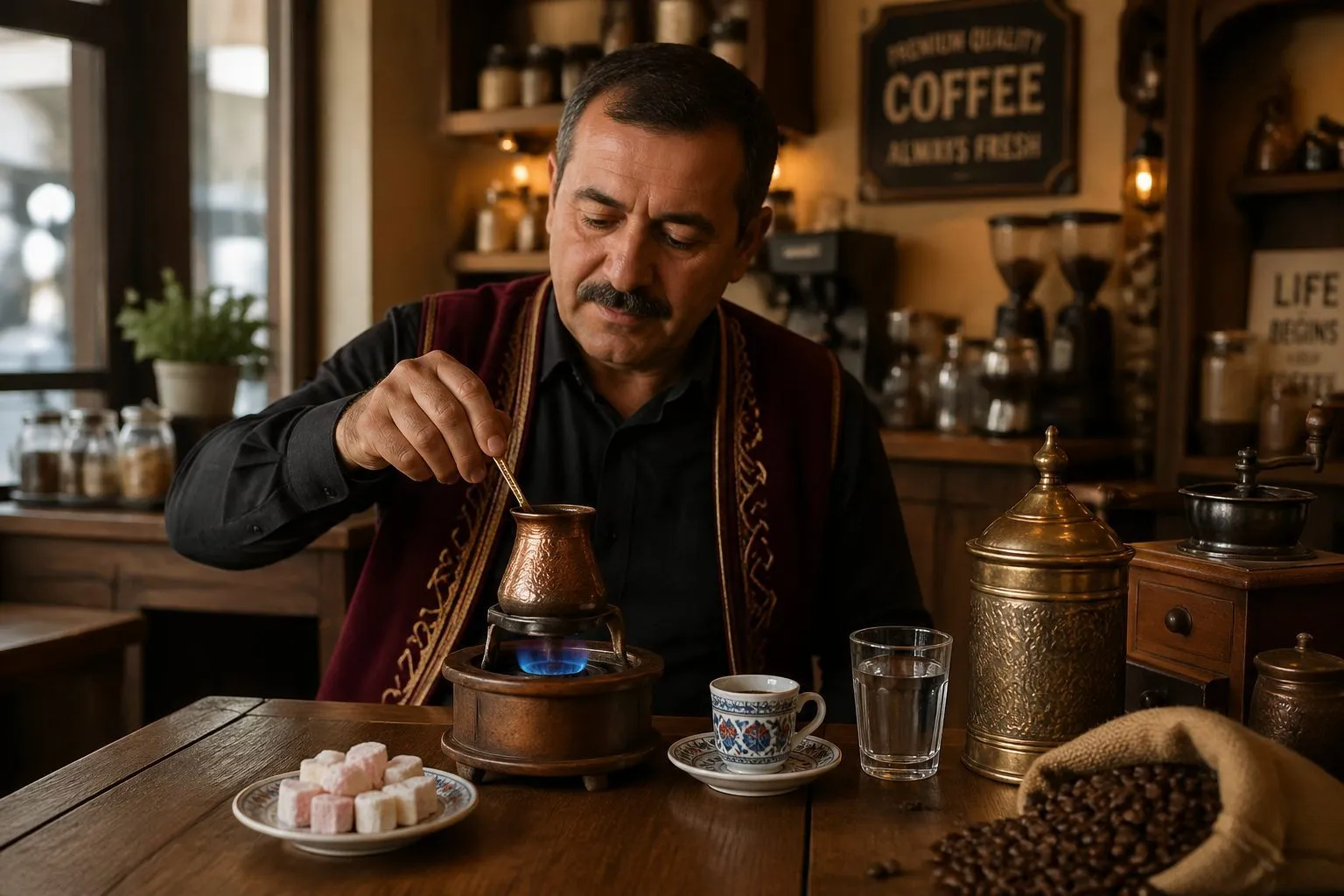
The classic pot is the cezve, sometimes called an ibrik, and it is usually copper with a long handle and a narrow neck. That shape concentrates heat and helps create the foam people expect from cezve coffee.
If you want the short version of how to make Turkish coffee, measure cold water and coffee into the cezve, add sugar if you use it, then heat gently and watch like a hawk. Pull it off before it boils hard, because a rolling boil flattens the foam and makes the cup taste tired.
| Tool or choice | What it changes | Practical tip |
|---|---|---|
| Cezve size | Foam stability and overflow risk | Use a pot that matches your serving count, not a big one for one cup |
| Grind fineness | Body, bitterness, and sediment texture | Ask for Turkish grind or use a grinder that can go near powder |
| Heat level | Foam formation and aroma retention | Keep the heat low to medium, never walk away |
| Water quality | Clarity of flavor | Use fresh, cold water, avoid heavily chlorinated tap water |
| Sugar timing | Sweetness integration | Add sugar before heating, then stir once and stop |
How Turkish coffee is served and what accompanies it
Turkish coffee comes in small cups, often with a saucer that feels almost ceremonial in the hand. The portion is modest, but the intensity makes it feel complete.
A glass of water usually arrives alongside it, and that is not decoration. You sip water first to clear your palate, then you let the coffee take over.
Sweets matter, and Turkish delight is the famous pairing, but it is not the only one. You might get a square of chocolate, a spoonful of jam, or a bite of something nutty like cezerye in southern Turkey.
In many homes, the host chooses cups that match the occasion, and the set might come out only for guests. That small act signals respect, the same way a tablecloth does at dinner.
Coffee often comes after a meal, especially when conversation is expected to linger. The cup gives everyone a reason to slow down and stay seated.
Coffee and hospitality: what offering a cup means in Turkish culture
In Turkish coffee culture and tradition, offering a cup is a social promise that you have time for someone. You can decline politely, but accepting means you are willing to sit and talk.
Hospitality has its own choreography, and coffee is one of the clearest examples. The host asks how you take it, then makes it the way you said, because the point is attention, not performance.
There is also the famous marriage custom where a prospective bride may serve coffee to the groom’s family, sometimes with salt added to the groom’s cup as a playful test. People debate how common it still is, but everyone seems to know the story, which tells you something about its staying power.
Coffeehouses handle hospitality differently, with regulars who expect their usual cup and a chair that stays “theirs” without anyone saying so. The best places remember your preference, and they do it quietly, the way a good bartender does.
Even the pace of drinking carries meaning, because finishing too fast can signal impatience. Leaving a little coffee at the bottom is normal, since the grounds settle there and nobody wants grit between their teeth.
Tasseography: reading fortunes in the coffee grounds
Turkish coffee fortune telling, often called fal, begins when the drinker finishes and leaves the grounds in the cup. The cup is turned onto the saucer, left to cool, then lifted so the patterns can be read.
Some people treat it like party entertainment, and others take it surprisingly seriously. Either way, it keeps the table going, because everyone leans in and argues about what a shape looks like.
- Turn the cup onto the saucer while it is still warm
- Wait several minutes for the grounds to settle and cool
- Look for large shapes first, then smaller marks
- Check the rim area for near term events
- Notice repeated symbols, like roads, birds, and hearts
- Compare cup patterns with marks on the saucer
Turkish coffee as UNESCO intangible heritage
UNESCO added Turkish coffee culture and tradition to its Intangible Cultural Heritage list in 2013. The recognition focuses on the social practices around preparation and sharing, not on a single official recipe.
I like that framing, because it admits what anyone who has watched families make coffee already knows. The method is consistent, but the meaning comes from who makes it, who drinks it, and how the moment is handled.
The UNESCO listing also pushes institutions and communities to document tools, stories, and training, so knowledge does not vanish with older generations. Museums, municipal programs, and cultural centers in Turkey have used that momentum to run demonstrations and workshops.
There is a tension here, because heritage labels can freeze a living practice into something that feels like a performance. The best coffee still comes from ordinary kitchens and small cafes, where nobody talks about heritage while the cezve heats up.
Outside Turkey, the listing has helped people recognize Turkish coffee as its own category rather than a novelty. That matters when menus flatten everything into “strong coffee” and miss the point.
From bean to cup: sourcing, roasting, and the grind that makes it work
Historically, the Ottoman market relied heavily on beans from Yemen, and that origin still shows up in stories about Turkish coffee history. Today, roasters in Turkey use beans from Brazil, Ethiopia, Colombia, and many other origins, then roast and blend for a familiar profile.
Roast level tends to sit around medium to medium dark, because very light roasts can taste sour and thin in this method. Very dark roasts can turn ashy fast when you simmer them, especially if your heat runs hot.
The grind is where most home attempts go wrong, and it is why people keep searching for how to make Turkish coffee that tastes right. If the particles are too large, the cup loses body and the foam looks weak, then bitterness shows up in an unpleasant way.
Pre ground Turkish coffee works well when it is fresh, but it stales quickly because the surface area is huge. If you buy it, buy small amounts, keep it sealed, and treat it like a spice you want to protect.
Regional brands like Kurukahveci Mehmet Efendi have become reference points for many households, partly because they keep the grind consistent. Specialty roasters now produce Turkish grind single origins too, and some of them taste great, but they can be less forgiving.
Brewing at home: a practical method that respects tradition
People ask for how to make Turkish coffee as if there is one correct script, but there are a few workable paths. What matters is fine grind, cold water, gentle heat, and stopping before a hard boil.
Start with about one demitasse cup of water per serving and roughly a heaping teaspoon of coffee per cup, then adjust to taste. Stir once at the beginning to dissolve coffee and sugar, then leave it alone so foam can form cleanly.
As the surface rises, take the cezve off the heat and spoon a little foam into each cup, then return it briefly to build the final rise. This step looks fussy, but it keeps the foam even across cups, and it avoids one person getting a sad, flat top.
Pour slowly, aiming to keep foam on the surface, and give the cup a minute so the grounds can settle. If you drink immediately, you will taste grit first, and that is a rough introduction for newcomers.
If you use a sand heater, the process becomes even gentler, because the heat surrounds the pot instead of blasting one spot. Many cafes use sand for show, but it also makes it easier to control temperature when you are making cup after cup.
Health and caffeine: benefits, myths, and what a small cup really delivers
Turkish coffee has the same core coffee compounds people talk about in health research, including caffeine and antioxidants like chlorogenic acids. The cup is small, but the brew is concentrated, so it can hit harder than it looks.
Because the grounds stay in the cup, you also keep more diterpenes like cafestol than you would in paper filtered coffee. That is a tradeoff, since those compounds can raise LDL cholesterol for some people, especially with heavy daily intake.
On the benefit side, many people use it for alertness and appetite control, and the ritual can support digestion after a meal simply because it slows you down. I buy the calm part more than the miracle claims, since sitting and talking after dinner helps regardless of the drink.
If you are sensitive to caffeine, order it less often or choose decaf roasted for Turkish grind, which some roasters now offer. Pregnant people and anyone with heart rhythm issues should treat it like any other strong coffee and follow medical advice.
The biggest myth is that foam proves quality or strength, when it mostly proves technique and freshness. A well made cup has foam, but a foamy cup can still taste flat if the coffee is stale.
Production and sustainability: where Turkish coffee fits in a changing coffee economy
Turkey does not grow coffee commercially at scale, so Turkish coffee depends on imported green beans and the global supply chain. That makes sustainability a real issue, because climate stress in producing countries shows up quickly in price and availability.
If you care about impact, start by buying from roasters who publish origin information and pay attention to sourcing rather than hiding behind generic blends. Certifications can help, but direct relationships and transparent pricing often tell you more than a logo.
Turkish coffee also has a low waste footprint compared with pod machines, since you do not throw away capsules and you rarely use paper filters. You do end up with wet grounds, and those grounds compost well if you have a bin or a garden.
Energy use depends on your setup, and a small cezve on a gas flame can be efficient because it heats quickly and uses little water. Electric sand heaters look romantic, but they can draw a lot of power if they run all day for show.
One practical sustainability move is to brew only what you will drink, because reheating ruins flavor and wastes energy. Another is to store coffee properly so you do not toss stale grounds, since waste often starts in the kitchen, not on the farm.
Conclusion
Turkish coffee endures because it fits human life, guests arrive, conversations stretch, and someone puts water on the stove. The method is simple, but the social rules around it are detailed, and that is why it keeps pulling people back.
If you came here for how to make Turkish coffee, the advice is straightforward, grind fine, heat gently, and stop before a hard boil. If you came for Turkish coffee culture and tradition, pay attention to the cup handoff, the pause after sipping, and the way the table stays together.
Turkish coffee history, cezve coffee craft, and Turkish coffee fortune telling all point to the same idea, the cup is a tool for connection. Make it at home, order it in a cafe, or accept it when it is offered, then give it the time it asks for.
Why Melbourne Became One of the World’s Great Coffee Cities
» Discover special tips and stories about coffee