The Ethiopian Coffee Ceremony: Ritual, Culture, and Meaning
In many coffee countries, people talk about beans, roast levels, and brew ratios, but in Ethiopia the conversation often starts with the ceremony. The Ethiopian coffee ceremony culture turns a daily drink into a public act of respect, patience, and community.
If you have only seen coffee made in a hurry, the buna ceremony Ethiopia can surprise you with how slow and deliberate it is. The pace is the point, because it gives neighbors time to talk, argue, laugh, and settle small problems before they grow.
Ask where coffee began and you will hear the phrase coffee origin Ethiopia, sometimes said with pride and sometimes with a shrug because Ethiopians have lived with coffee for so long it can feel obvious. The ceremony keeps that origin story alive in a practical way, through smell, sound, and repetition.
This ritual also answers a question visitors constantly ask, which is how Ethiopian coffee ceremony works in real homes rather than in staged tourist shows. The real thing is messier, warmer, and more personal, and it changes depending on the household and the day.
It is also one of those traditions that teaches you by making you sit still. You learn what matters by watching what people refuse to skip, even when they are tired.
In a world where coffee is often treated like a product category, the ceremony treats it like a relationship. That difference is why people remember it long after they forget the exact flavor notes.
What Would You Like to Learn Next?
Choose an option below:
The cultural significance of coffee in Ethiopia
Coffee in Ethiopia is a social tool, and people use it the way other places use a long lunch or a porch sit. Ethiopian coffee ceremony culture creates a reason to gather even when money is tight and schedules are crowded.
The ceremony often marks ordinary moments, like welcoming a neighbor, and big ones, like holidays and family visits. In many communities, skipping the Ethiopian coffee tradition when guests arrive reads as cold or disrespectful.
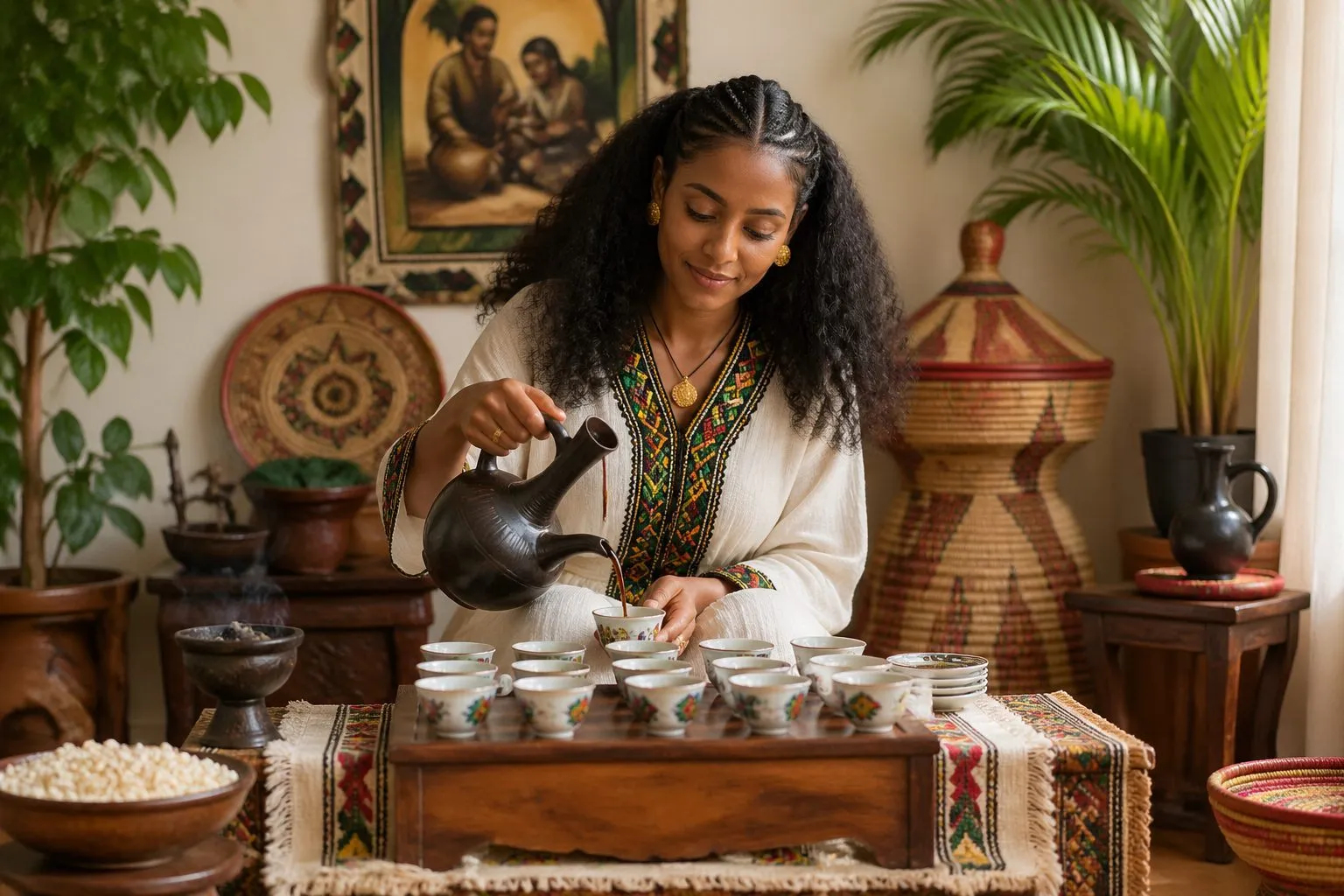
There is also a moral edge to the practice, because it trains patience and attention in a world that rewards speed. You cannot rush roasting beans over charcoal without burning them, and everyone watching knows it.
Religious and cultural calendars shape when and how people drink, especially in Orthodox Christian and Muslim households with fasting periods. Even then, the buna ceremony Ethiopia stays flexible, and families adjust snacks, timing, and conversation to fit the day.
For Ethiopians in the diaspora, the ceremony can become a bridge back to language and family memory. A jebena on a stove in Minneapolis or London can pull people into the same rhythms they knew at home.
It also works as a soft form of neighborhood governance, because people use the time to exchange news and check on each other. When someone has been sick, had a new baby, or lost a job, the ceremony becomes a place to notice and respond.
In many homes, children learn manners through coffee long before they understand coffee itself. They watch when to greet elders, when to offer a seat, and how to speak without turning every conversation into a fight.
The ceremony is not only about harmony, because it can hold disagreement too. People can argue during coffee, but the shared cups and repeated rounds push the room toward resolution instead of escalation.
There is a quiet education in it as well, because the host demonstrates craft in public. Everyone sees what good roasting looks like, and everyone knows the difference between a careful pour and a careless one.
Even the choice to hold a ceremony on a given day can be a message. It can mean, “I have time for you,” or “I am open to talk,” or sometimes, “Let’s clear the air.”
When people talk about Ethiopian coffee ceremony culture as tradition, they sometimes miss how practical it is. It organizes social life in a way that feels natural, and it gives structure to hospitality without needing formal invitations.
It also creates a shared sensory memory that outlasts the moment. The smell of roasting coffee can bring back a specific room, a specific voice, and a specific kind of laughter years later.
How the ceremony works: step by step
Most ceremonies start with preparing the space, often with fresh grass or flowers spread on the floor and a low table set with small cups. That setup is not decoration for its own sake, it signals that guests matter enough to receive care.
The host washes green coffee beans, then roasts them in a flat pan over charcoal until they turn dark and glossy. The smell is shared on purpose, and the host wafts the smoke and aroma toward guests so everyone participates before a single sip.
After roasting, the beans are ground, traditionally with a mortar and pestle, though some homes use a hand grinder. The sound of grinding is part of the room’s rhythm, and it tells people the coffee is truly being made right there.
The grounds go into a clay pot called a jebena with water, and the host brings it to a boil, often lifting it and setting it back down to control heat. When the coffee rises in the neck of the pot, the host pulls it away quickly to keep it from spilling.
Pouring is careful and practiced, with a high, thin stream into handleless cups arranged close together. If you want to understand how Ethiopian coffee ceremony works, watch the pour, because it shows skill, pride, and years of repetition.
Before roasting even starts, the host may rinse cups and set out sugar, salt, or small snacks depending on the household. The point is to remove friction so guests can relax and focus on the gathering.
In some homes, the host also prepares a small brazier and checks the charcoal like a cook checks a stove. The heat has to be steady, because uneven charcoal makes the roast unpredictable.
The roasting itself is not passive, because the beans are stirred and watched closely. A good host knows when the color is right by sight and smell, not by a timer.
When the host wafts the aroma toward guests, it is not only for enjoyment. It is a kind of invitation that says, “Be here with me,” and most people respond with comments and blessings.
Grinding can take time, and that time is part of the ceremony’s built-in patience. The mortar and pestle also produce a texture that feels different from machine-ground coffee, even if you cannot name it.
The jebena is more than a pot, because it shapes the whole method. Its narrow neck and rounded body encourage a boil-and-settle rhythm that becomes almost meditative to watch.
Some hosts add a little cool water to calm the boil, and others simply move the jebena off the heat for a moment. Either way, the goal is the same: control without rushing.
When the coffee is ready to pour, cups are often arranged tightly so the stream can move from one to the next without stopping. The host may start with elders or honored guests, which is etiquette disguised as logistics.
Sugar is common, but not mandatory, and people take it according to taste and region. In some places, salt is used instead, which surprises outsiders but makes sense once you try it with a dark roast.
Conversation flows around the work, not instead of it. The host is listening while roasting and pouring, and guests are watching while talking, so the whole room stays connected.
By the time the first cups are served, the ceremony has already done its job of gathering people into one shared moment. The coffee is the reward, but the process is the glue.
The three rounds: abol, tona, and baraka
The ceremony traditionally includes three rounds of coffee, and people talk about them like chapters in the same conversation. Ethiopian coffee ceremony culture treats the first round as the strongest and most direct, the one that wakes up the room.
Abol comes first, then tona, then baraka, and each round uses the same grounds with more water added. The cups keep coming even when you think you are done, because the Ethiopian coffee tradition values staying present over optimizing caffeine.
The first round can feel almost intense, especially if you are used to lighter roasts or paper-filtered coffee. It is thick with aroma, and the bitterness, when it shows up, is treated as part of the honest flavor of coffee.
Tona is where the room often relaxes, because the urgency of the first sip is gone. People lean back, refill snacks, and shift from greetings into real talk.
By baraka, the coffee is gentler, and the mood can turn reflective. The name itself carries the idea of blessing, so people may offer kind words or end the visit on a softer note.
Not everyone drinks all three rounds, but the invitation matters even when you decline. Accepting at least one cup is a common way to show respect, and staying for more is a way to show closeness.
The three rounds also stretch resources without making anyone feel poor. Instead of hiding scarcity, the Ethiopian coffee tradition turns careful use into a respected norm.
Each round gives the host a chance to recalibrate the room. If conversation gets tense, the next pour can be a reset button that brings people back to manners.
For guests, the repeated cups create a rhythm that makes it easier to stay. Leaving immediately after one cup can feel abrupt, like walking out in the middle of a sentence.
There is also a simple physical reality: drinking coffee slowly gives people time to eat, digest, and talk. The ceremony is designed for human bodies, not for speed.
In some households, the rounds are accompanied by small shifts in snacks or seating. Those small changes keep the gathering alive and prevent it from feeling like a performance stuck on repeat.
When people remember a great ceremony, they often remember the arc, not the first sip. The three rounds create that arc, moving from energy to ease to goodwill.
| Round | What it tastes like | What people associate with it |
|---|---|---|
| Abol | Strong, bold, most aromatic | Opening the conversation, waking the senses |
| Tona | Softer, smoother, less intense | Settling in, longer talk, sharing news |
| Baraka | Light, gentle, easy to drink | Blessing, goodwill, closing on peace |
| Common practice | Same grounds, fresh water added | Respect for tradition, stretching resources |
The role of the host and the meaning of hospitality
The host, often a woman in many households, runs the ceremony with a mix of grace and authority. She controls the timing, the roast, the boil, and the pace of serving, and the room follows her lead.
Hospitality here is active, not symbolic, because the host works the whole time while guests sit and talk. In the buna ceremony Ethiopia, that labor is respected, and people notice if someone cuts corners.
Offering incense is common in some homes, and it changes the smell of the room in a way that marks the gathering as special. Even when incense is not used, the roasting smoke itself becomes a kind of announcement to the neighborhood.
Guests also have a role, because they accept the coffee and give the host social credit by staying and engaging. Refusing without a good reason can come off as dismissive, especially in settings where the Ethiopian coffee tradition is tied to respect for elders.
There is a practical side to this hospitality that people outside Ethiopia sometimes miss. Brewing in rounds lets a family host many guests with a small amount of coffee, which matters in rural areas and during hard seasons.
The host is also a kind of conductor, because she manages multiple tasks without breaking the social flow. She can roast, pour, and still track who has arrived, who is quiet, and who needs to be greeted properly.
In many settings, the host’s skill is a source of pride for the whole household. A well-run ceremony reflects well on the family, the way a well-kept home does.
Hospitality is measured in attention, not in expensive ingredients. Even a simple ceremony can feel rich if the host is generous with time and care.
Guests often praise the host’s coffee, and those compliments are part of the exchange. They are not empty flattery, because roasting and pouring really do vary from person to person.
Sometimes the host will insist you take another cup, and the insistence is its own language. It can mean you are welcome, or it can mean the host wants more time to talk with you.
Children and younger relatives may help by bringing cups, fetching water, or serving snacks. That help is also training, because it teaches them how to host before they are ever in charge.
The meaning of hospitality shows up in small details like keeping cups clean and pouring evenly. If one guest gets a weak cup while another gets all the strength, people notice, so the host pours with fairness in mind.
In some ceremonies, the host will pause to let the coffee settle before pouring again. That pause feels like a reminder that the room is not supposed to be rushed, even if everyone has somewhere to be.
When visitors romanticize the ceremony, they often focus on aesthetics and miss the social discipline behind it. The host’s work is a form of leadership that keeps the gathering respectful and functional.
Coffee varieties used in the ceremony
The beans used can be whatever a family has, but many people prefer local lots with familiar flavors. When someone says coffee origin Ethiopia with a straight face, they often mean specific places like Sidama, Yirgacheffe, or Harar, not a vague national label.
In much of Ethiopia, arabica is the norm, and the cup can lean floral, citrusy, or winey depending on region and processing. Natural processed coffees, common in some areas, can taste fruit-forward, which plays well with the ceremony’s slow sipping.
Some families blend beans from different sources, mixing what they bought at market with what they received from relatives. That blending is part preference and part economics, and it keeps the Ethiopian coffee ceremony culture grounded in real household choices.
Roast level during the ceremony often goes darker than what many specialty cafes in the United States call ideal. I like that about it, because the darker roast fits the charcoal fire, the clay pot, and the long conversation better than a delicate, lightly roasted profile.
Spices are not always added to the coffee itself, but some communities use cardamom or other aromatics, and many serve snacks that change how the coffee reads. Popcorn, roasted barley, peanuts, or bread can make a strong cup easier to handle across three rounds.
At the household level, the “best” coffee is often the coffee that is available and trusted. People may prefer beans from a certain market stall because they know the seller and the quality is consistent.
In some rural areas, families may have access to coffee through local networks that feel almost informal. That closeness to the supply makes coffee origin Ethiopia feel less like a story and more like daily reality.
Processing style matters even when people do not use the technical words for it. A natural coffee can make the room smell sweeter during roasting, while a washed coffee can come across cleaner and sharper in the cup.
Freshness is valued, but not always in the specialty-coffee sense of roast dates and sealed bags. Freshness here often means the beans were bought recently, stored carefully, and roasted right in front of you.
Green beans are sometimes stored in simple containers, and families learn through experience what keeps them stable. The ceremony makes storage visible, because you see the beans before they become coffee.
The roast can be adjusted to the crowd, which is something cafes rarely do. If elders like it darker and guests prefer it slightly lighter, a skilled host can land in the middle.
Even when the roast goes dark, it is not automatically burnt, because the host is constantly stirring and watching. The difference between dark and burnt is attention, and the ceremony rewards attention.
Some people drink the coffee black, and others add sugar until it turns into something closer to dessert. The ceremony holds both preferences without judgment, because the point is togetherness, not purity.
Snacks also act like a flavor bridge, especially for visitors who are not used to strong coffee. A handful of kolo or a piece of bread can make the cup feel balanced and calm.
When you taste Ethiopian coffee in this context, you taste it as part of a meal of conversation and time. That is why the same beans can feel different in a ceremony than they do in a modern cafe.
How the ceremony differs across regions and communities
People sometimes talk about the Ethiopian coffee ceremony as if it is one fixed script, but Ethiopia is huge and culturally diverse. The buna ceremony Ethiopia looks different in Addis Ababa than it does in a rural Oromo household or in parts of Tigray.
Urban ceremonies may use electric burners or a quicker setup, especially on weekdays when people have work and school. Rural ceremonies more often use charcoal, and the whole process can stretch longer because time works differently when neighbors live nearby.
Language and etiquette shift too, including how people invite others to sit, how they praise the roast, and how they handle silence. If you want to learn Ethiopian coffee tradition properly, you listen first, because every community has its own cues.
Some households emphasize incense and formal seating, while others keep it simple and focus on conversation. Both versions count, and I tend to trust the simpler ones more because they usually happen for real reasons, not for show.
Season and religion can change the snacks and the timing, and even the mood of the gathering. During holidays, the ceremony can feel like a public living room, with people coming and going and the coffee cycling for hours.
In some regions, the ceremony is tightly linked to daily routine, happening at similar times like a shared clock. In other places, it is more event-driven, used to mark visits, negotiations, or special afternoons.
Even within one city, you can see differences based on family background and income. Some homes have a dedicated coffee corner with all the tools, and others improvise with what they have.
The size of the gathering changes the feel of the ceremony. A small ceremony with two or three people can be intimate and quiet, while a large one can turn into a lively, overlapping conversation.
In some communities, elders play a more formal role in guiding the talk, and younger people speak less. In others, the ceremony becomes a place where younger voices can be heard because the setting is relaxed.
Tools vary too, and not every jebena looks the same. Some are plain and heavily used, and others are more decorative, but both can produce excellent coffee when handled well.
Water source can even shape the taste, especially in rural areas where water has its own mineral character. People rarely frame it as “water chemistry,” but they know some water makes better coffee.
In parts of the country, snacks like popcorn are almost expected, while in other places kolo or bread is more common. The snack choice can signal region as clearly as an accent does.
Some ceremonies include more ritual language, including blessings and formal greetings, while others keep words minimal. The quieter versions can feel just as meaningful, especially between close friends.
Modern life also changes the ceremony in small ways, like using pre-roasted beans when time is tight. Even then, many families still try to keep the most important parts, like serving in rounds and making space for talk.
Tourist-facing ceremonies sometimes exaggerate the most photogenic elements, which can make outsiders think that is the only real version. The everyday Ethiopian coffee ceremony culture is less polished, and that is exactly why it feels alive.
- Charcoal fire versus electric burner
- Incense used or skipped
- Grass and flowers on the floor or bare setup
- Popcorn, kolo, bread, or no snacks
- Urban quick ceremony versus long rural gathering
- Regional bean preference, like Harar or Sidama
What the Ethiopian coffee ceremony means for coffee history
When people argue about coffee history, they often focus on trade routes, colonial ports, and European cafes. The Ethiopian coffee ceremony culture is a reminder that coffee started as a community practice in its home region, long before it became a global commodity.
The phrase coffee origin Ethiopia is not marketing copy, it connects to real botany, because Coffea arabica is native to Ethiopian forests. Wild and semi-wild coffee still grows in places like Kaffa and Bench Sheko zones, which keeps the origin story tied to living ecosystems.
The ceremony also shows how brewing methods travel, because the jebena style of boiling and pouring has influenced neighboring regions and diaspora communities. You can see echoes of it in how people value aroma, communal cups, and repeated pours in other coffee cultures.
There is a hard truth here too, because Ethiopia grows some of the world’s most prized coffee while many farmers earn little. If you care about coffee history, you should care about who profits now, not only who discovered what centuries ago.
Buying Ethiopian coffee through transparent importers, cooperatives, or direct trade models can support better outcomes, though no system is perfect. The ceremony’s slow pace almost dares you to slow down as a buyer too, read the sourcing notes, and ask where the money goes.
The ceremony also complicates the way people tell the story of “invention.” Coffee was not just found once and then shipped out, because it was shaped by daily use, local knowledge, and repeated practice.
When you watch someone roast and grind in front of you, you see how close coffee is to cooking. That closeness helps explain why coffee became so adaptable, because it started as a kitchen craft before it became an industry.
The emphasis on aroma and freshness challenges the idea that coffee culture is a modern invention. Ethiopian coffee ceremony culture has been treating smell as central for a long time, without needing tasting wheels or lab language.
It also highlights how coffee’s value is not only in taste but in what it does socially. A coffee that brings people together can be “good” even if it would not score high in a competition.
From a historical perspective, the ceremony is also a record of continuity. It shows how a plant native to a region can become a daily anchor rather than an export story alone.
The ceremony’s tools matter in this history, because clay, charcoal, and small cups point to older domestic technologies. They remind you that coffee was not born in stainless steel, even if that is how it is sold today.
The three rounds are a kind of historical clue too, because they suggest a culture that learned to stretch and share. That matters when you think about how coffee moved through households before it moved through corporations.
When Ethiopians in the diaspora keep the ceremony alive, they also keep a version of coffee history alive. It is history carried in hands and habits, not only in books.
If you care about coffee origin Ethiopia in a serious way, you end up caring about forests, farmers, and local markets, not only about cafe menus. The ceremony keeps pointing back to those roots, because it never lets coffee become abstract.
Conclusion
The Ethiopian coffee ceremony culture asks for time, and that request can feel radical if you are used to coffee as fuel. Once you have sat through the roast, the pour, and the three rounds, a paper cup on the run starts to seem a little lonely.
The Ethiopian coffee tradition also keeps coffee origin Ethiopia connected to daily life rather than museum talk. It ties agriculture, hospitality, and craft into one practice that ordinary people keep doing because it works.
If you want to experience how Ethiopian coffee ceremony works, look for a home-style ceremony or a community gathering where conversation matters more than performance. Show up on time, accept at least one cup, and treat the host’s work with the respect it deserves.
After that, the next time you buy beans labeled Ethiopia, you may taste more than fruit notes and florals. You may remember the sound of grinding, the smell of roasting, and the quiet social power of sharing coffee face to face.
You may also notice how the ceremony changes your own sense of what coffee is for. It makes “quality” feel bigger than flavor, because it includes care, attention, and the willingness to sit with others.
Even if you never own a jebena, you can carry the lesson into your own kitchen. Slow down, make enough to share, and let the drink be an excuse to be human for a while.
The Ethiopian coffee ceremony culture survives because it fits real life, not because it is frozen in the past. It adapts, it travels, and it keeps teaching the same simple thing: coffee is better when it connects people.
Why Melbourne Became One of the World’s Great Coffee Cities
» Discover special tips and stories about coffee