Why Coffee Bean Density Matters
Learn how coffee bean density impacts your brew. Discover the importance and how to measure coffee bean density for optimal flavor.
Density is simply the ratio of mass to volume, but in roasting and brewing it becomes a practical tool for predictability. For home brewers and small roasters, knowing how much matter fits into a given space helps explain why two beans that weigh the same can behave very differently when roasted or ground.
This short guide aims for useful, repeatable measurement rather than lab perfection. You’ll see two common at-home methods: free-settled bulk measurement and water displacement. Most people prefer free-settled readings because they stay consistent and avoid ruining green lots.
Why it matters: denser seeds often roast differently, show a tighter internal structure, and change extraction rate. That affects cup quality and the final flavor you taste. We’ll also cover why volume-based scoops drift while gram weights stay steady.
Who should read this: home brewers seeking consistent cups and small roasters wanting a simple QC metric to log. The article follows farm-to-roast causes and kitchen-to-cup measurement tactics so you can plan roasts and brew with fewer surprises.
Key Takeaways
- Density links mass-to-volume and helps predict roast and brew behavior.
- Free-settled bulk measurement is the most practical at-home method.
- Denser seeds often yield different roast dynamics and extraction.
- Weighing in grams is more repeatable than volume scoops.
- This guide is for home brewers and small roasters aiming for consistent cups.
What Bean Density Means and Why It Changes What’s in Your Cup
Understanding how mass fills space gives you a simple tool to predict roast and brew behavior.
Mass versus volume is the core idea: density = weight divided by volume (grams per milliliter). In practical terms, it answers how much material is packed into the space your scoop or hopper holds.
What Would You Like to Learn Next?
Choose an option below:
Relative density: a practical target for roasters and brewers
Rather than chasing a single absolute value, most home brewers and small roasters use relative density. Compare one lot to another to guide roast time and grind settings.
How denser beans affect extraction
Denser beans tend to have a tighter cell structure. That compactness slows water access during extraction and can concentrate sugars and acids differently than looser beans.
Same weight, different volume — why it matters
Two lots can weigh the same while occupying different volume. That explains why a scoop-based recipe drifts between coffees, while a weight-based recipe stays stable.
- What you might notice: faster or slower extraction times.
- Grind response can change; finer or coarser adjustments behave differently.
- Taste shifts toward under- or over-extraction if scoop dosing replaces grams.
Understanding this point gives roasters and brewers a clearer starting place to dial in a consistent cup across different coffees.
What Impacts Coffee Bean Density From Farm to Roast
Farm conditions set the starting point for how compact a lot will roast and grind.
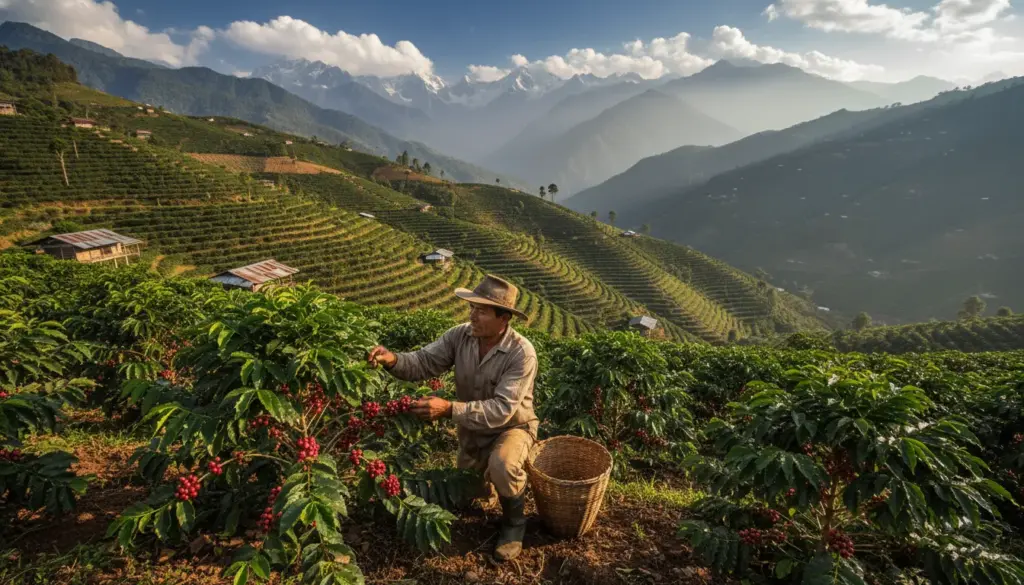
Higher altitudes often correlate with denser green coffee because cooler nights slow cherry ripening. Slower ripening gives more time for cell multiplication, which usually raises density over time.
Altitude is a strong signal but not an absolute rule. Origin, processing, and plant variety act as additional factors and can produce notable differences between lots.
Growing and processing factors
- Cool nights at higher altitudes → slower ripening → more cell development → higher readings.
- Processing (washed vs natural) can shift measurements; washed lots sometimes read higher in direct comparisons.
- Variety and origin change size and internal structure, so two lots at similar elevations may behave differently.
Roast level and grind effects
Roast level alters expansion and brittleness, so a light roast will occupy different volume than a dark roast at the same weight.
Grind size changes packing: finer grounds pack tighter and raise grams per scoop; coarser grinds trap more air and reduce it. That makes volume dosing variable.
| Stage | Main factor | Typical effect |
|---|---|---|
| Farm | Higher altitudes / time | Slower ripening, more cell growth, higher compactness |
| Processing | Washed vs natural | Can shift volume and measured values between lots |
| Roast | Level | Expansion and brittleness change scoop fill |
| Grind | Size | Packing behavior alters grams per scoop |
Practical takeaway: when measuring coffee by volume, roast level and grind introduce dose variation that can change your brew even if the recipe stays the same. For repeatable results, track measurements and adjust for these factors in your roaster or brewing log.
How to Measure Coffee Bean Density at Home or in a Small Roastery
A simple, repeatable method will give you the best actionable readings at home or in a small roastery.
Tools and setup: a digital scale with 0.1 g resolution, a straight-walled graduated cylinder (100 mL common) or PVC tube, and a consistent fill-to mark. Calibrate a container by filling it with water and weighing that volume in grams.
Free-settled (bulk) method
Fill the cylinder without tamping and level to the same mark each time. Weigh the sample in grams and record the volume in mL.
Calculation and precision
Use metric: density (g/mL) = grams ÷ milliliters. Multiply by 1000 to log g/L. Larger fill volumes reduce random swings and improve precision.
Repeatability protocol
- Take at least three readings.
- Record each reading and calculate the average.
- Flag outliers from inconsistent leveling or pour technique.
Displacement (water) method
Measure water level before and after adding green coffee; displaced volume = difference. This often reads higher because water penetrates voids, but it can ruin samples and suffer from surface-tension errors. For routine checks, bulk is preferred.
| Step | Tool | Why it matters |
|---|---|---|
| Calibration | Container + water + scale | Defines trusted mL mark for consistent volume |
| Bulk reading | Graduated cylinder + scale | Simple, repeatable, representative of hopper fill |
| Displacement | Beaker + water + scale | Shows true occupied volume but damages green samples |
Best practice: pick one vessel and one method, log readings, and compare lots only within that system for consistent, useful results.
How to Use Density Readings for More Consistent Brewing and Roasting Results
A quick density reading gives practical clues you can use at the grinder and the roaster the same day.
Brewing consistency: scale vs. scoop
Weighing in grams is the most reliable way to keep strength steady. A digital scale removes the variability that comes from roast level and grind size.
Volume scoops change as roasts expand. Darker roasts often yield fewer grams per scoop than lighter roasts, which creates strength shifts when water and volume stay fixed.
Roasting considerations
Denser beans usually conduct heat better and can move through roast phases faster. Softer lots often need gentler profiles to avoid scorching and to reach even development.
Treat a density reading as one input for charge temp, gas strategy, and development time—not the only factor.
Track readings in your roast log
Record the reading with roast level, batch size, and sensory notes. Over time the data helps predict how a lot will extract and what grind or time changes to try.
- Use weight-based dosing for brewing consistency.
- If you must use a scoop, test grams per scoop by roast level and adjust.
- Log readings to spot outliers and improve quality across batches.
Conclusion
A quick metric, taken the same way each time, makes dialing in new lots much faster.
Density is simply mass divided by volume, and its practical value comes from comparing one lot to another with the same tool and method.
Use the free-settled (bulk) method for the best balance of effort and repeatability. Log each reading with roast level, origin, and process so you build useful data over time.
Expect variation from higher altitudes, processing, and roast level. Brewers should move from scoops to grams and keep water ratios steady. Roasters should add readings to roast notes to define a useful range for their setup.
Consistent measurement and logging reduce guesswork and make quality more repeatable across coffees and roast levels.
FAQ
What does "mass vs. volume" mean when measuring beans and which should I use?
How do denser seeds affect extraction and flavor potential?
Why can the same weight look like a different volume and brew differently?
What farm factors increase seed compactness at harvest?
Is altitude the only thing that affects compactness and weight-per-volume?
How does roast level and grind size change measurements when using a scoop?
What tools do I need at home or in a micro roastery to measure mass-per-volume reliably?
How does the free settled (bulk) measurement work?
How do I calculate mass-per-volume and why do larger volumes help precision?
How can I get reliable results and cut operator error?
What about the water displacement method—when does it help or hurt?
Do vessel shape and device type change readings and which should I standardize?
How do I use mass-per-volume measurements to dose by weight instead of scoops?
What roast-log entries should I track alongside these measurements?
Cold Brew with Single Origin Beans: Bright vs Chocolatey Results by Region
» Discover special tips and stories about coffee