Roast Development Time Explained Simply
Understand coffee roast development and its impact on flavor. Get a step-by-step guide to mastering roast development for better coffee.
Development time is the span after first crack that shapes whether a batch lands light, medium, or dark. Think of it as the finish line where sugars, acids, and oils change the cup profile.
You will learn how to find first crack, measure the finish period, and calculate the development time ratio so you get repeatable results. The guide shows simple tweaks to heat and airflow to steer results on your machine.
What you taste — sweetness, acidity, body, clarity, and roasty notes — ties directly to those final minutes. You cannot fix early stages later; drying and Maillard set the base for that finish.
Times and temps vary by roaster, probe placement, and batch size. Use bean temperature, exhaust readings, and RoR as a compact dashboard to make steady choices and improve your roasting experience.
Key Takeaways
- Development time affects final flavor and clarity.
- Find first crack, then time the finish to calculate DTR.
- Smooth RoR avoids harsh spikes and baked notes.
- Early stages set outcomes; you can’t fully fix them later.
- Track bean temp, exhaust temp, and RoR for control.
What Roast Development Time Means and Why It Changes Coffee Taste
Measuring the finish period as a share of total time gives a clearer flavor forecast than minutes alone. Development time starts at first crack and runs to the end. It is the portion that nudges sugars, acids, and oils toward the final cup.
Development time vs total roast time and why the ratio matters
Development time is a window; total roast time is the whole process. Two roasts can have the same minutes after crack but very different pacing and outcomes.
What Would You Like to Learn Next?
Choose an option below:
Expressing that window as a development time ratio or time ratio (a percentage of total roast) standardizes comparisons across machines and batch sizes.
How development influences sweetness, acidity, body, and clarity
Shorter finish tends to preserve acidity and clarity. Longer finish often lowers perceived acidity and can mute origin-specific notes.
Think of the ratio as a flavor dial: tweak it to favor sweetness, body, or clarity depending on the goal.
What “underdeveloped,” “baked,” and “burnt” can taste like in the cup
Underdeveloped coffees can taste green, grassy, or thin with astringent peanut-skin notes. This happens when the inside lags behind the surface.
“Baked” profiles read as dull sweetness, flat aroma, or papery, old-bread character. They often link to stalled momentum rather than simply shorter time.
Overdone end points turn ashy, smoky, and bitter. More time past a sensible ratio does not guarantee better flavors—balance matters.
The Roast Phases That Set Up Development After First Crack
A simple three-phase model gives a practical way to control flavor without obsessing over every 30 seconds.
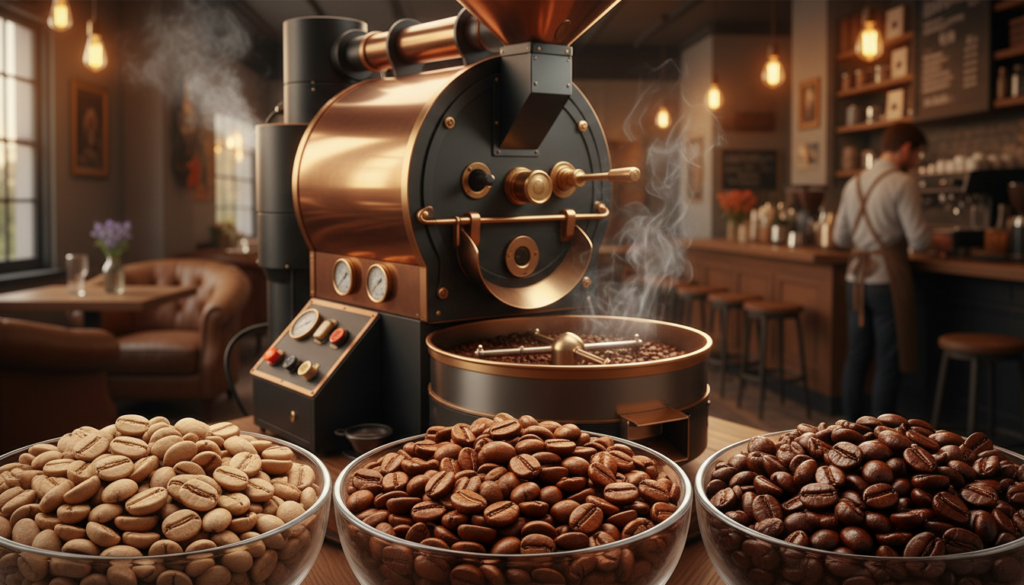
Many roasters break the process into Drying → Maillard → Development. This framework helps you steer moisture, heat, and color so later choices matter.
Drying: managing moisture, momentum, and inner bean pressure
Drying is often near 5–6 minutes. It’s more about building momentum and inner bean pressure than only moisture loss.
Too much early heat brings tipping, craters, or scorching. Too little energy yields weak-bodied, flavorless cups.
Maillard: building sweetness and body between yellowing and first crack
Maillard runs from yellowing/color change to first crack, usually 3–4 minutes. Browning reactions here create sweetness and body.
Watch RoR and temperature after yellowing. Excessive spikes can shorten this point and reduce complexity.
Development: finishing choices that define light, medium, or dark
After first crack, finishing locks in what Drying and Maillard prepared. The final minutes refine clarity, sweetness, and body.
Use a steady, declining RoR and controlled heat to avoid baked or harsh notes. First crack is the practical marker for logging and repeatability.
| Phase | Typical Time | Key Focus | Warning Signs |
|---|---|---|---|
| Drying | ~5–6 min | Moisture loss, momentum, inner pressure | Tipping, scorching, weak cup |
| Maillard | ~3–4 min | Color change, sweetness, body | RoR spikes, shortened browning |
| Development | From first crack to drop | Finish, clarity, roast level | Late RoR surges, baked or ashy notes |
How to Identify First Crack and Use It as Your Development Starting Point
A clear first crack makes timing repeatable. Listen for a rapid series of pops or snaps—often compared to popcorn or a small branch breaking. Watch for visible bean expansion and a shift in aroma at that moment.
Why timing varies: Probe placement, roaster design, and batch size change how and when the crack appears. On some systems the bean temperature at first crack reads near 380–390°F, but probes differ so use the sound as your primary cue.
Typical timing and quick interpretations
- Early crack <~6 minutes — may indicate an aggressive charge or high initial heat; risk of scorching or hollow beans.
- Common light-roast target ~7–9 minutes; many darker or espresso styles see crack ~10–11 minutes.
- Late crack >~11 minutes — may signal low early energy and risk of baked, dull cups.
“Use the first audible pop as your log point — record timestamp, BT/ET, and RoR to build consistent results.”
| Item to Record | Why It Matters | Example Value |
|---|---|---|
| Timestamp | Baseline for development time | 08:12 (min:sec) |
| BT / ET | Context for thermal state | ~385°F / 450°F (system dependent) |
| RoR before/during | Shows momentum and risk of spikes | 5–2°F/min declining |
coffee roast development: How to Measure Development Time and Development Time Ratio
Start by marking the exact moment the first audible crack begins—this timestamp is your anchor for all finish calculations.
How to log development time from first crack start to drop
- Mark first crack start time (min:sec).
- Mark drop time when beans leave the drum.
- Record total roast time and save BT, ET, and RoR snapshots at both points.
- Note audible crack strength, smoke level at drop, and any control changes (gas/airflow).
How to calculate development time ratio as a percentage of total roast time
Use the formula: DTR = (development time ÷ total roast time) × 100.
Example: 10:00 total time with 1:45 development equals (1.75 ÷ 10) × 100 = 17.5% DTR.
Practical DTR targets for very-light to light profiles
Targets commonly sit around 15–20%. Shorter percentages help keep acidity and clarity while still finishing Maillard reactions.
Using BT, ET, and RoR together
Read BT for bean progress, ET as a fast-response heat indicator, and RoR as the trend or momentum line. ET often predicts where BT is headed. A smooth, declining RoR supports balanced cups. Beware software smoothing, probe lag, and sampling rates; keep consistent settings for repeatable reads.
| Item | What to record | Why it matters |
|---|---|---|
| First crack time | Timestamp, audible strength | Anchor for DTR and first crack development context |
| Drop time | Timestamp, smoke level | Defines end of development and extraction targets |
| BT / ET / RoR | Snapshots at start and drop | Shows thermal state, momentum, and risk of spikes |
“Simple logs and consistent probe settings turn intuition into repeatable profiles.”
How to Control Development with Heat, Temperature, Airflow, and Momentum
Gentle, predictable changes in heat and airflow let you guide the beans through first crack and on to a reliable finish.
Why a smooth, declining RoR curve supports balanced flavors
A gently declining RoR is a practical proxy for steady momentum. When the curve falls smoothly, sugars and acids transform without sharp stress.
This shape links to balanced sweetness, clear acidity, and fuller mouthfeel. Sudden spikes often mean acrid notes; sudden dives can yield baked, flat cups.
When to reduce heat before first crack to avoid RoR spikes
Reduce heat and power in small, timed steps before first crack. Doing this lowers the risk of exothermic “flicks” when the beans go exothermic.
Don’t wait to “fix” a spike after it starts. A small pre-crack reduction gives a lower, steadier rate through the finish.
Airflow strategy: retain moisture earlier, clear smoke later
Keep moderate airflow early to help retain moisture, especially for dry or low-density lots.
Then increase airflow near and after first crack to clear smoke and improve crack audibility. The right balance protects clarity and aroma.
Charge temperature, preheat time, and batch size choices
Charge temperature and preheat time set the roaster’s starting energy. They commit you to a pace you can’t fully correct mid-run.
Small batch size reacts fast to changes—easy to overshoot. Large loads have inertia and need earlier planning.
| Control | Action | Effect |
|---|---|---|
| Heat / temperature | Reduce in small steps before first crack | Smoother RoR, fewer spikes |
| Airflow | Moderate early, increase late | Retains moisture, clears smoke |
| Charge temp / preheat | Set appropriate mass and energy | Predictable timing, avoids late recovery |
| Batch size | Adjust timing and controls by load | Small loads change fast; large loads need early moves |
“A steady curve wins more cups than aggressive corrections.”
Choosing Development Targets for Light, Medium, and Dark Roast Profiles
Decide the flavor you want first, then use time and heat to get there reliably. Pick a target profile—bright and clear, balanced, or deep and smoky—and set a finish plan that matches.
Typical ranges and flavor tradeoffs
Practical ranges: light ~1:45, medium ~2:30, dark ~3:00+. These examples depend on total time and momentum.
Shorter finishes keep brightness and clarity. Longer finishes reduce acidity and add body and roast character. The ratio you choose balances those tradeoffs.
Light roast approach
Lower RoR into first crack and keep a gently declining RoR through the finish. That stores just enough energy to avoid stalling yet prevents a runaway spike.
Medium and dark approach
For darker profiles, maintain steadier momentum so the run moves toward second crack without scorching. Increase control on heat and temperature to avoid heavy smoke and ash.
Second crack considerations and decision framework
Second crack brings more smoke and surface oils. There is a narrow window where depth becomes bitterness.
- Choose sweetness/brightness goals, then set a development time ratio and end temperature for your machine.
- Record first crack and drop times so choices are repeatable across batches.
Troubleshooting Roast Curves That Ruin Development
Sharp late accelerations and long stalls both harm final flavor; diagnosing the curve is the fastest fix.
RoR flicks near drop: A late RoR flick—an abrupt rise in rate—often imprints a sharp, acrid acidity and harsh notes in the cup.
Common causes include a late heat increase or a sudden cutoff of airflow that forces the drum to sprint. Even if the earlier process looked clean, that last-minute energy spike can dominate flavor.
RoR crashes and stalling: When the rate collapses or sits near zero, beans lose momentum and enter a baked zone.
That pattern mutes sweetness, flattens aroma into papery or cardboard-like character, and reduces clarity and body.
Probe and software quirks
Probes and smoothing algorithms can exaggerate flicks or dips. First crack is exothermic, so readings may show sudden swings that reflect probe location or software sampling, not true internal bean temperature.
Quick verification and fixes
- Compare BT, ET, and recent control moves. If ET roller-coasters after a gas tweak, the RoR change is likely real.
- Check probe placement and software smoothing settings to rule out measurement anomalies.
- Fixes: lower late heat in small steps to prevent flicks; add gentle energy before first crack to avoid stalls; moderate airflow changes to prevent sudden cooling.
“Match the cup defect to the curve: flick = harsh acidity; crash = baked flatness; sustained high RoR = smoky bitterness.”
Record each run and link the curve to coffee taste. Over time, these checks turn surprises into predictable control over flavor.
Conclusion
Treat first crack as your stopwatch start, and steer the final minutes with small, deliberate moves.
Two simple metrics give immediate clarity: log the finish in minutes and convert it to a percentage of total time (the ratio). Use both numbers to compare runs across batch sizes and machines.
Control stack: set charge and preheat thoughtfully, build steady momentum, keep airflow purposeful, and aim for a smooth, declining RoR into and through the finish.
Keep a repeatable workflow: record timestamps and sensory notes, rest and cup, then change only one variable per roast. That makes learning clear and results predictable.
The goal is practical: consistent, sweet, balanced coffee with acidity and roast character that match your profile. Remember—temperature readings vary by roaster and probe, so calibrate targets to your machine and cup.
FAQ
What does roast development time mean and why does it change flavor?
Why does the development time versus total roast time ratio matter?
How can I tell if a batch is underdeveloped, baked, or burnt in the cup?
What are the key phases before and after first crack?
How should I manage moisture and momentum during the drying phase?
What happens during the Maillard phase and why is it important?
Why is first crack the starting point for development time?
What does first crack sound like and how can timing vary?
How do I log development time from first crack start to drop?
How is development time ratio calculated as a percentage of total roast time?
What are practical DTR targets for very-light to light levels?
How can bean temperature, exhaust temperature, and rate of rise be used together?
Why does a smooth, declining RoR curve support balanced flavors?
When should heat be reduced before first crack to avoid spikes?
How does airflow strategy affect moisture and smoke during a run?
Why are charge temperature and preheat time critical set-and-forget factors?
How does batch size impact machine responsiveness?
What are typical development time ranges by roast level and their flavor outcomes?
How should I approach light-level profiles with RoR entering first crack?
What changes for medium and dark approaches toward second crack?
When should I consider second crack and its impact on surface oils and bitterness?
Why do RoR flicks near drop cause harsh notes?
How do RoR crashes and stalling create baked flavors?
How can probe placement and software quirks affect perceived crashes?
What practical steps help when curves ruin the final cup?
Why Cheap Coffee Often Tastes Burnt
» Discover special tips and stories about coffee