Why Your Coffee Tastes Different Every Morning
Get the perfect cup every time with our guide on achieving coffee brew consistency. Tips on adjusting your brew method for optimal taste.
Small changes add up. A tiny shift in dose, grind size, water temperature, or brew time will alter extraction and change the way your cup tastes. That explains why the same routine can still surprise you.
At home, rushed measuring, inconsistent kettle heat, and grinder retention make mornings prone to drift. If your extraction is low, the cup often tastes sour or weak. Too much extraction makes it bitter or harsh.
Think of strength as concentration and extraction as the balance of flavors you pull. Both matter when you seek a reliable cup.
This short guide shows a practical workflow: pick a method, standardize inputs, dial in your recipe with grams, and change only one variable at a time. Later sections include grams-based examples and quick “fix today’s cup” tips so you can correct a brew without wasting a whole morning.
Key Takeaways
- Minor changes in ratio, grind, time, or temp change extraction and taste.
- Home routines drift due to fast mornings and gear quirks.
- Strength ≠ extraction; both shape the final flavor.
- Standardize inputs, then adjust one variable at a time.
- Later sections offer grams-based recipes and quick fixes for a perfect cup.
What Actually Changes From Brew to Brew (Even When You Do “The Same Thing”)
Even when your routine looks the same, hidden variables quietly alter the result. Small differences in gear, beans, or water add up and change extraction and flavor.
Grinder variability is a common culprit. Numbers or clicks don’t transfer between machines. Burr wear, calibration, and model differences change particle output, so a setting that worked yesterday may not today.
What Would You Like to Learn Next?
Choose an option below:
Why that matters: a wide spread of fines and boulders makes extraction uneven. More fines push a cup toward harsh or bitter notes. More large particles can leave the cup thin or sour.
Extraction is simply how much solubles water pulls from the grounds. It depends on grind size, water temperature, and contact time. These three interact: faster methods (espresso) need much finer grind than long immersion (cold brew).
Water at home is another hidden variable. Filtration, mineral content, and kettle temp shifts change how flavors extract. Aim for a predictable hot range of 195–205°F for most hot methods.
Quick diagnostic: bitter/harsh usually means too much extraction; sour/weak usually means too little. Once you see what changes, you can lock variables in the next section.
Coffee Brew Consistency Starts With Controlling the Variables
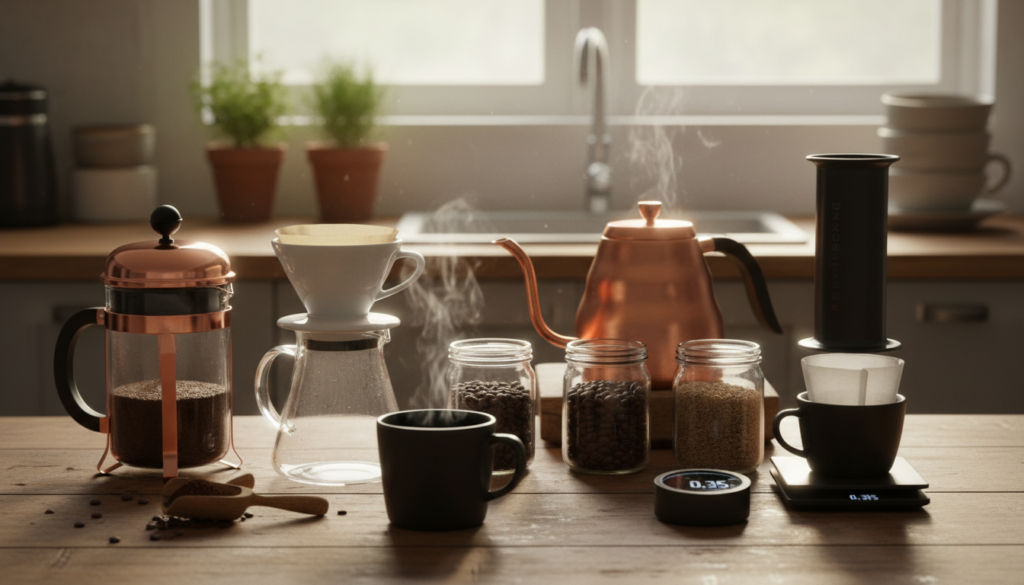
Locking a single approach removes most day-to-day surprises in your cup. Pick one brew method and use it for a week. That removes the biggest source of variation: switching between methods each morning.
Pick one approach and commit
Choose drip, pour over, French press, espresso, or cold brew and stick with it for seven days. Treat the trial like an experiment so patterns become obvious.
Standardize dose, yield, and time
Dose is the grams of dry grounds you add. Yield is grams of liquid out in the cup or carafe. Tracking both makes comparisons cleaner than using “cups.”
Use a short daily checklist: weigh coffee, weigh water, start a timer, and note the result. Record brew time and any adjustments so you learn what affects flavor.
The one-change rule
If a cup tastes off, change only one variable: grind size, ratio, or brew time. This keeps fixes repeatable. Once method, dose, yield, and time are stable, ratio becomes the easiest lever to fine-tune flavor on purpose.
Dial In Your Coffee-to-Water Ratio for Repeatable Flavor
A clear, repeatable ratio turns guesswork into a predictable cup. The coffee-to-water ratio is a weight-based recipe that controls strength and helps you compare results no matter the batch size. Use grams, not volume, to make each attempt measurable.
Golden starting points and when to use them
Start around 1:16–1:17 for a balanced everyday cup. Try 1:18 when you want a lighter, cleaner profile or when following SCA batch targets (about 55 g per liter).
Method-based ratio ranges (grams in → grams water)
| Method | Common Range | Example (grams) |
|---|---|---|
| Drip / drip coffee | 1:16–1:18 | 60 g → 1000 g |
| Pour over | 1:14–1:17 | 25 g → 400 g |
| French press / press | 1:12–1:16 | 30 g → 450 g |
| Espresso | ~1:2 (ratio in:out) | 18 g → 36 g |
| Cold brew concentrate | 1:5–1:8 | 100 g → 800 g |
Quick math and practical tips
Choose how many grams of water you want, then divide by your ratio to find grams of grounds. Example: 10 oz ≈ 283 g water ÷ 17 = ~16.5 g grounds. Reverse: grounds × ratio = water grams.
Why a digital scale wins: tablespoons measure volume and vary by grind and roast. A scale gives repeatable grams so strength and extraction become controllable. Once ratio is stable, adjust grind size to fine-tune extraction and taste.
Choose the Right Grind Size for Your Brewing Method
Particle size sets the pace: small pieces extract quickly, large ones slowly.
Match grind targets to your method so you stop chasing flavor with random changes.
- Espresso: very fine — tiny adjustments flip shots from sour to bitter.
- Drip / pour over: medium — balanced flow for clear flavor.
- French press / press: coarse — larger particles preserve smoothness in long steeping.
- Cold brew: extra coarse — long contact time supports big particles.
Filter shape and grind nuance
Cone filters tend to pull faster and often work best with a slightly finer medium grind.
Flat-bottom filters can benefit from a coarser medium grind to avoid slow flow or channeling.
Why choose a burr grinder
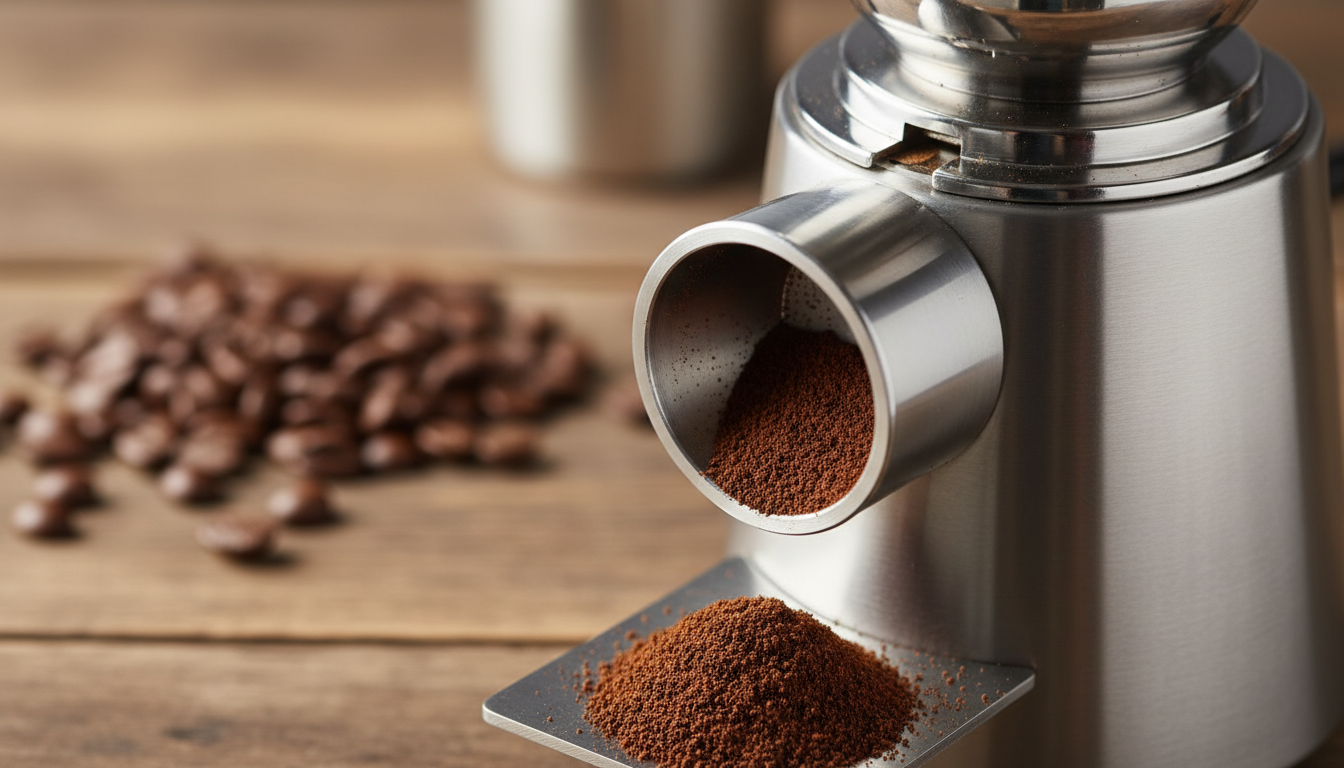
Burr grinders produce uniform particle sizes. Uniform grinds reduce uneven extraction and make recipes repeatable even when you change beans.
“Burrs create more even extraction than blades, which mix dust and chunks.”
Avoid blade grinders for daily use. Their uneven grinds cause simultaneous over- and under-extraction, which reads as muddled flavor.
Simple adjustment rule
If a cup tastes bitter or harsh, try a coarser grind or a shorter contact time. If it tastes sour or weak, try a finer grind or a bit more time.
Fix Today’s Cup: A Practical Troubleshooting Guide for Taste and Strength
Start by tasting and naming the dominant fault in your cup—bitter or sour—then act with a simple, ordered fix. This saves time and keeps experiments repeatable.
If your cup tastes bitter or harsh
Likely cause: over-extraction pulls too many solubles.
- Go slightly coarser on the grind. Make one small step and test.
- Shorten brew time next if coarser grind didn’t help.
- Adjust ratio last—move one step from 1:17 to 1:16 to increase strength only if needed.
If your cup tastes sour or weak
Likely cause: under-extraction or low concentration.
- Go slightly finer with the ground. Small changes matter, especially for espresso.
- Extend brew time if flow or contact was too fast.
- Increase concentration by nudging the ratio toward 1:16 if the cup is too thin.
Water temperature and method notes
Keep water between 195–205°F for predictable extraction. Home kettles and machines vary; filter and stable temps help drip and pour methods.
Espresso reacts to tiny grind shifts—track input and output in grams. Drip methods tolerate larger steps but still benefit from measured changes.
“If strength is off, change the ratio; if balance is off, change grind or time first.”
| Problem | First Fix | Second Fix |
|---|---|---|
| Bitter / harsh | Go coarser | Shorten brew time |
| Sour / weak | Go finer | Extend brew time |
| Thin strength | Adjust ratio (e.g., 1:17 → 1:16) | Reduce water or increase grounds slightly |
Even pours and even saturation avoid channeling. Take a quick note of your recipe and result so the next attempt is an informed step toward the perfect cup.
Conclusion
Write one baseline recipe, then repeat it three mornings before changing anything. Pick a single method, weigh beans and water on a digital scale, and use a golden-ratio neighborhood like 1:16–1:17 as your starting point.
Match grind size to that method and prefer a burr grinder for stable particle output. Keep water near 195–205°F so extraction behaves predictably.
Treat ratio as the primary lever for strength; use grind and time to fix extraction and dial flavor. Remember that grinder settings are not universal—target particle size and taste, not a number copied online.
For a practical starter kit, assemble: a burr grinder, a digital scale, and one chosen brew method to test for a week. Then note one recipe (grams coffee, grams water, time) and track results.
FAQ
Why does my coffee taste different even when I follow the same steps?
How does grind variability affect flavor and why do settings not match across grinders?
What role do time, grind size, and contact play in extraction?
Can my tap water change the taste of each cup?
How should I start if I want consistent results every morning?
What are practical ratio starting points for repeatable flavor?
How do method-based ratio ranges differ for drip, pour over, French press, espresso, and cold brew?
How do I calculate a recipe in grams for any cup size?
Why is a digital scale better than tablespoons or scoops?
How should I adjust the recipe for a stronger or lighter cup?
What grind sizes match each brew method?
Do filter shape and design change extraction for drip and pour over?
Why are burr grinders preferred over blade grinders?
If my cup tastes bitter or harsh, what should I do now?
If my cup tastes sour or weak, how do I fix it?
What temperature range gives the most predictable extraction?
Why Cheap Coffee Often Tastes Burnt
» Discover special tips and stories about coffee