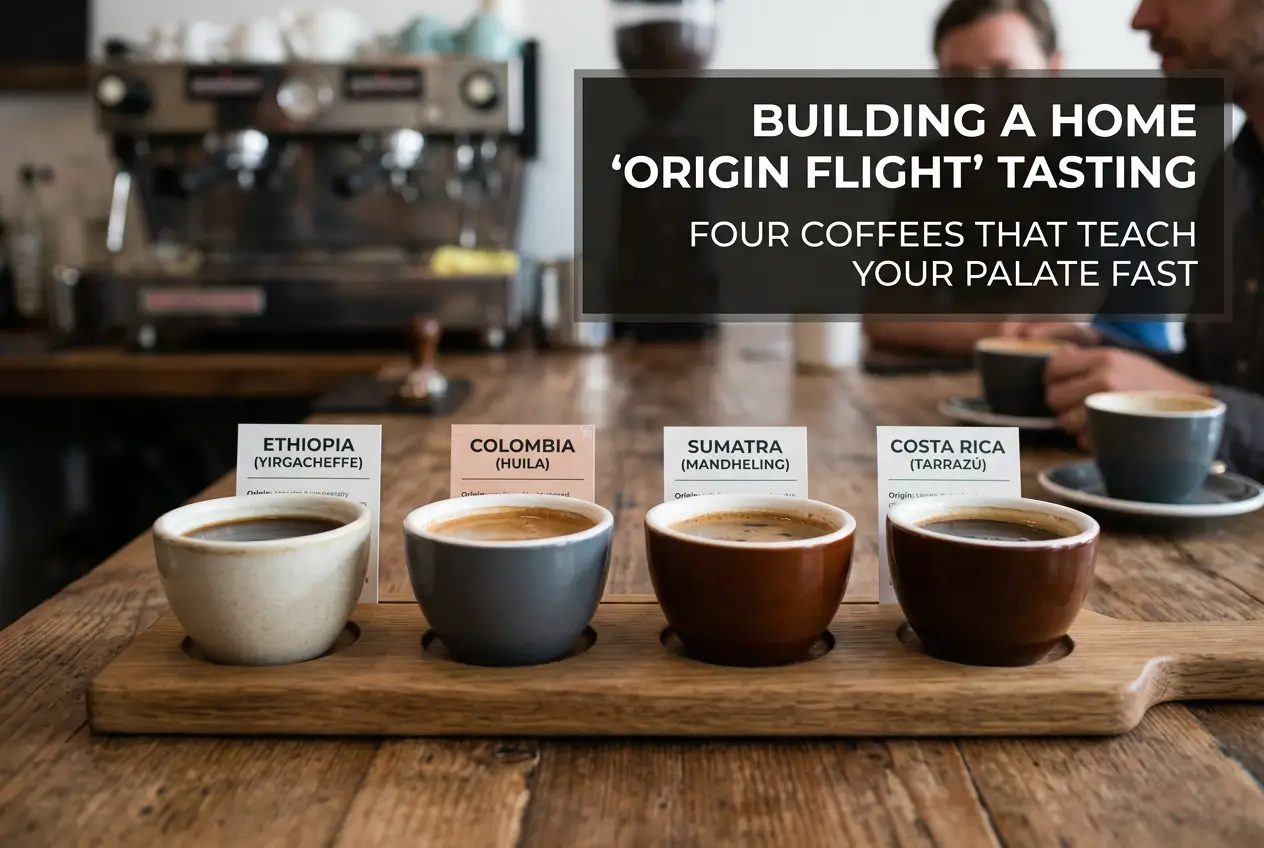
Building a Home “Origin Flight” Tasting: Four Coffees That Teach Your Palate Fast
Want to understand specialty coffee like a pro? Building a home “origin flight” is the fastest way to train your palate.
This simple tasting method teaches you to spot the unique flavors from different coffee-growing regions.
This guide gives you a step-by-step plan to host your own tasting and finally understand what makes each coffee special.
What is a Coffee “Origin Flight”?
Think of it like a wine tasting, but for coffee. An “origin flight” is a side-by-side tasting of coffees from different countries.
The goal is to highlight how geography, soil, and climate—what the industry calls terroir—shape the flavors in your cup.
By tasting them together, your palate learns to recognize distinct flavor profiles. You don’t need to be a barista to do it.
What Would You Like to Learn Next?
Choose an option below:
Four Coffees That Teach Your Palate Fast
For an effective tasting, you need contrast. These four regions offer dramatically different profiles, perfect for beginners.
Look for single-origin bags with a light to medium roast. This style preserves the unique flavors of the bean’s origin.
- Ethiopia (Floral & Fruity): Known as the birthplace of coffee. Expect bright, vibrant acidity with notes of blueberry, bergamot, and jasmine. The body is often light, similar to tea.
- Colombia (Balanced & Sweet): A classic, crowd-pleasing profile. Look for smooth, balanced flavors of chocolate, caramel, and nuts. It has a medium body and a clean, sweet finish.
- Brazil (Chocolaty & Nutty): The world’s largest coffee producer delivers comfort in a cup. These beans have low acidity, a heavy body, and deep notes of chocolate and roasted nuts.
- Indonesia/Sumatra (Earthy & Bold): This coffee is a world apart. It’s known for its full body and earthy, herbal, and sometimes spicy notes like cedar or dark chocolate. Acidity is very low.
How to Set Up Your Tasting at Home
The professional method for tasting is called “cupping.” It sounds technical, but it’s just a way to keep everything consistent.
This ensures you’re tasting the differences in the beans, not in how you brewed them. Here’s what you’ll need.
Your Essential “Cupping” Toolkit
You probably have most of these items already. Precision is more important than having fancy gear.
- Whole Bean Coffee: Your four single-origin coffees.
- Grinder: A burr grinder is best for a consistent grind.
- Digital Scale: For measuring coffee and water accurately.
- Kettle: One that lets you control water temperature is ideal.
- Cups or Bowls: One for each coffee, all the same size (about 7-9 oz).
- Spoons: Soup spoons work fine. Get a few for tasting and skimming.
- Timer: Your phone’s timer is perfect.
- Filtered Water: Avoid tap water, which can affect taste.
- Extras: Pen and paper for notes, and cups with hot water to rinse spoons.
Step-by-Step Guide to Your Origin Flight
Follow these steps precisely for all four coffees. Consistency is the key to a successful tasting experience.
- Set Up: Line up your cups and label them so you know which coffee is which.
- Measure & Grind: Weigh 11 grams of coffee for each cup. Grind it to a medium-coarse consistency, like coarse sea salt. Clean the grinder between each coffee.
- Smell the Dry Grounds: Add the grounds to each cup and take a moment to smell them. This is the “dry fragrance.” Write down what you notice.
- Heat Water: Bring filtered water to a boil, then let it sit for about a minute. The ideal temperature is 195-205°F (90-96°C).
- Pour and Start Timer: Start your timer and pour 200 ml (about 7 oz) of hot water over the grounds in each cup. Make sure all the grounds are saturated.
- Wait 4 Minutes: A crust of coffee grounds will form on top. Let the coffee steep undisturbed for exactly four minutes.
- Break the Crust: At the 4-minute mark, bring your nose close to the cup. Use the back of a spoon to gently push the crust back. Inhale the powerful aromas released.
- Skim the Top: After breaking the crust, use two spoons to skim any remaining grounds and foam from the surface. A clean surface makes tasting easier.
- Cool and Taste: Let the coffee cool for another 5-10 minutes. The flavors are much clearer when it’s not scalding hot.
- Slurp Loudly: Dip your spoon in and take a small sip. Slurp it quickly and forcefully. This sprays the coffee across your entire palate, revealing more flavors.
Pro Tip: Taste from lightest to heaviest. Start with Ethiopia, then Colombia, Brazil, and finish with the bold Sumatra. This prevents stronger flavors from overwhelming your palate early on.
How to Take Notes (and What to Look For)
Don’t worry about using fancy words. Just write down what comes to mind. Your notes are for you.
Focus on a few key things as you taste each coffee:
- Acidity: Is it bright and zesty like lemon (Ethiopia) or smooth and mild (Brazil)?
- Body: How does it feel in your mouth? Is it light and tea-like or heavy and creamy like whole milk (Sumatra)?
- Flavor: What does it remind you of? Fruits, chocolate, nuts, spices? There are no wrong answers.
- Aftertaste: What flavor lingers after you swallow or spit? Is it sweet and clean or long and smoky?
As the coffees cool, taste them again. You’ll be surprised how much the flavors change and develop over time.
Where to Buy Quality Beans Online in the US
Finding fresh, high-quality, single-origin beans is crucial for a great tasting. Supermarket coffee won’t work here.
Look for roasters who print the “roasted on” date on the bag. Here are some trusted online retailers in the U.S.:
- Counter Culture Coffee: A leader in sustainability and coffee education, offering fresh, single-origin beans.
- Stumptown Coffee Roasters: Known for its meticulous sourcing and high-quality roasts.
- Intelligentsia Coffee: A pioneer in the specialty coffee scene with excellent direct-trade options.
- Trade Coffee: A subscription service that connects you with dozens of the nation’s best roasters.
- Bean Box: Offers a curated selection from top-rated roasters, perfect for discovering new coffees.
Final Tips for a Great Experience
Don’t get overwhelmed. The goal is to learn and have fun, not to become an expert in one afternoon.
Warning: Tasting four coffees can mean a lot of caffeine. Don’t be afraid to spit it out into a separate cup. The pros do it all the time to keep their palates sharp.
Doing this with a friend can also make it more fun. Comparing notes helps you both identify more flavors.
Your first origin flight is just the beginning. Grab some beans, follow these steps, and start your journey into a world of flavor.
Tasting Imported Coffee Like a Pro: A Simple Flavor Wheel Approach for Home Drinkers
» Discover special tips and stories about coffee