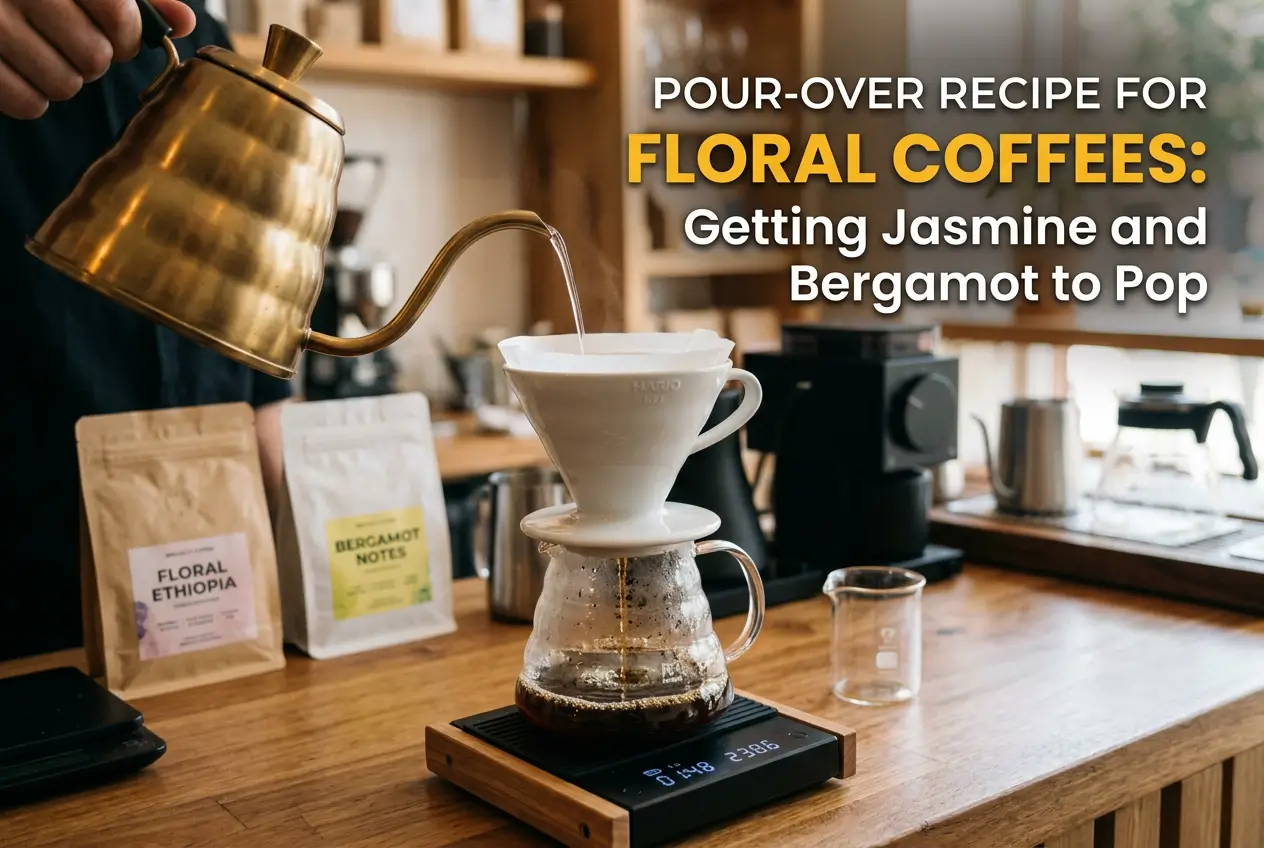
Pour-Over Recipe for Floral Coffees: Getting Jasmines and Bergamot to Pop
Ever buy a bag of coffee promising notes of jasmine or bergamot, only to brew a cup that tastes flat? You’re not alone. Those delicate floral flavors are elusive.
The secret isn’t just the beans; it’s the technique. This guide provides a precise pour-over recipe to make those floral notes pop, every single time.
We’ll walk you through the exact steps, from water temperature to pouring style. Get ready to finally taste the coffee you paid for.
Why Floral Coffees Need a Special Touch
Coffees with floral notes, like jasmine, and citrus notes, like bergamot, are typically light roasts. This means the beans are harder and denser than darker roasts.
The aromatic compounds that create these beautiful flavors are also extremely volatile. They can easily be destroyed by water that’s too hot or a brew time that’s too long.
A standard pour-over recipe can overwhelm these subtleties, resulting in a cup that’s either sour (under-extracted) or bitter (over-extracted).
What Would You Like to Learn Next?
Choose an option below:
Our goal is a gentle, controlled extraction. We want to pull out the sweetness and aromatics without introducing any harsh, undesirable flavors.
Your Essential Toolkit for a Perfect Brew
You don’t need a science lab, but a few key pieces of equipment are non-negotiable for consistency. Precision is what unlocks those delicate flavors.
- Burr Grinder: This is the most important tool. It creates uniform coffee grounds for an even extraction. Blade grinders produce dust and boulders, hiding flavor.
- Digital Scale with Timer: Brewing is about ratios. A scale ensures you use the right amount of coffee and water every time. The timer tracks your extraction.
- Gooseneck Kettle: The long, curved spout gives you total control over your pour. You can pour slowly and precisely where you want.
- Pour-Over Dripper: A Hario V60 or Kalita Wave is perfect. The V60 offers great flavor clarity, while the Kalita is known for its consistency.
- Paper Filters: Use filters that match your dripper. Always rinse them with hot water first to remove any papery taste.
Having the right tools removes guesswork. It makes a great cup of coffee repeatable, not just a happy accident.
Choosing the Right Beans and Water
Your technique can only highlight the flavors that are already in the bean. Start with high-quality ingredients for the best results.
Look for light-roast specialty coffee. The bag should list flavor notes like jasmine, bergamot, lavender, or other floral descriptors.
Freshness is critical. Buy beans that have a “roasted on” date printed on the bag. Aim for coffee roasted within the last 2 to 4 weeks.
Pro Tip: Coffees from Ethiopia, especially from the Yirgacheffe or Guji regions, are famous for their stunning floral and tea-like characteristics.
Don’t forget about your water. Coffee is over 98% water, so its quality matters immensely. Use fresh, filtered water for the cleanest taste.
Avoid using hard tap water or distilled water. Both can lead to a dull, lifeless cup.
The Recipe Vitals: Ratio, Grind, and Temperature
These three variables are the foundation of your brew. Let’s dial them in specifically for delicate floral notes.
| Parameter | Recommendation for Floral Coffees |
|---|---|
| Coffee-to-Water Ratio | Start with 1:17 (1 gram coffee to 17 grams water) |
| Grind Size | Medium-fine, like table salt or coarse sand |
| Water Temperature | 195°F to 200°F (90°C to 93°C) |
Why these settings? A 1:17 ratio creates a slightly lighter body, allowing the delicate aromatics to shine through without being weighed down.
The medium-fine grind provides enough surface area for proper extraction without taking too long, which could introduce bitterness.
Most importantly, the lower temperature range (195°F-200°F) is crucial. Water that’s too hot will literally “burn off” the fragile floral compounds you’re trying to taste.
Step-by-Step: The Floral Pour-Over Method
Here is the full process, from start to finish. For this example, we’ll use 17 grams of coffee and 289 grams of water (a 1:17 ratio).
- Prepare Your Water: Heat your filtered water to your target temperature (195°F-200°F). If you don’t have a temperature-control kettle, bring water to a boil and let it sit for about 60 seconds.
- Rinse Your Filter: Place the paper filter in your dripper. Pour hot water through it to rinse out any paper taste and to preheat your dripper and server. Dump this water out.
- Grind and Add Coffee: Grind your 17 grams of beans to a medium-fine consistency. Add the grounds to the filter and give it a gentle tap to create a flat, even bed.
- Start the Bloom (0:00 – 0:45): Start your timer. Pour 35-50 grams of water evenly over the grounds, ensuring they are all saturated. Let it sit for 45 seconds. You’ll see bubbles; this is CO2 gas escaping.
- The First Pour (0:45 – 1:15): Begin pouring slowly in a controlled, circular motion, starting from the center and spiraling out. Add water until the scale reads about 170 grams. Keep the stream gentle.
- The Second Pour (1:30 – 2:00): After the water level has dropped a bit, begin your second pour. Gently add the remaining water in the same circular pattern until you reach the total weight of 289 grams.
- Let it Drain (2:00 – 3:00): Allow all the water to drip through the coffee bed. The entire process, from the first drop of water to the last, should take between 2 minutes 45 seconds and 3 minutes 15 seconds.
- Serve and Enjoy: Once the dripping stops, remove the dripper. Give your brewed coffee a final swirl to mix the flavors and serve immediately.
Mastering the Bloom for Maximum Aroma
Don’t rush the bloom. This initial 45-second pre-infusion is where the magic begins for floral coffees. It’s more than just a setup for the main brew.
When hot water hits fresh grounds, trapped CO2 is rapidly released. If you skip the bloom, this gas can repel water during the main pour, causing uneven extraction.
An effective bloom ensures all grounds are saturated. This allows for a more uniform extraction, which is essential for highlighting nuanced flavors.
For very fresh, light roasts, you might even extend the bloom to a full minute. A gentle swirl of the dripper during this phase can help saturate any dry clumps.
Troubleshooting: When Your Coffee Doesn’t “Pop”
Even with a great recipe, you may need to make small adjustments. Coffee is an agricultural product, and every bag is different. Here’s how to fix common issues.
Remember the rule: Taste is your best guide. Use these tips as a starting point to dial in the perfect cup for your specific beans.
If your coffee tastes sour, thin, or grassy…
This is a sign of under-extraction. The water didn’t pull out enough of the good stuff. The fix is to grind your coffee slightly finer. This increases the surface area and slows the water down, boosting extraction.
If your coffee tastes bitter, dry, or harsh…
This points to over-extraction. The water pulled out too many undesirable compounds. The solution is to grind your coffee slightly coarser. This will speed up the flow of water and reduce overall extraction.
Make one small adjustment at a time. Change only the grind size, then brew again. This way, you’ll know exactly what worked.
Beyond the Recipe: Fine-Tuning Your Technique
Once you’re comfortable with the core recipe, you can experiment with subtle changes to further enhance those jasmine and bergamot notes.
Pay close attention to your pouring technique. A slow, steady, and gentle pour with your gooseneck kettle minimizes agitation of the coffee bed.
Too much agitation can lead to over-extraction, muddying the delicate flavors you want. Think of it as gently rinsing the flavor out, not blasting it.
Try dividing your main pour into three or four smaller pulses instead of two larger ones. This can sometimes lead to an even sweeter, more balanced cup.
The goal is to find what works best for the specific coffee you’re brewing. Trust your palate, take notes, and enjoy the process of discovery.
Brewing floral coffee is a delicate dance of precision and patience. Now you have the steps to lead. Grab your favorite beans and give this method a try.
Building a Home “Origin Flight” Tasting: Four Coffees That Teach Your Palate Fast
» Discover special tips and stories about coffee