Turbulence in Coffee Brewing Explained
Understand the role of coffee brew turbulence in your daily cup. Get tips on adjusting brewing methods to achieve ideal flavor profiles with our step-by-step guide
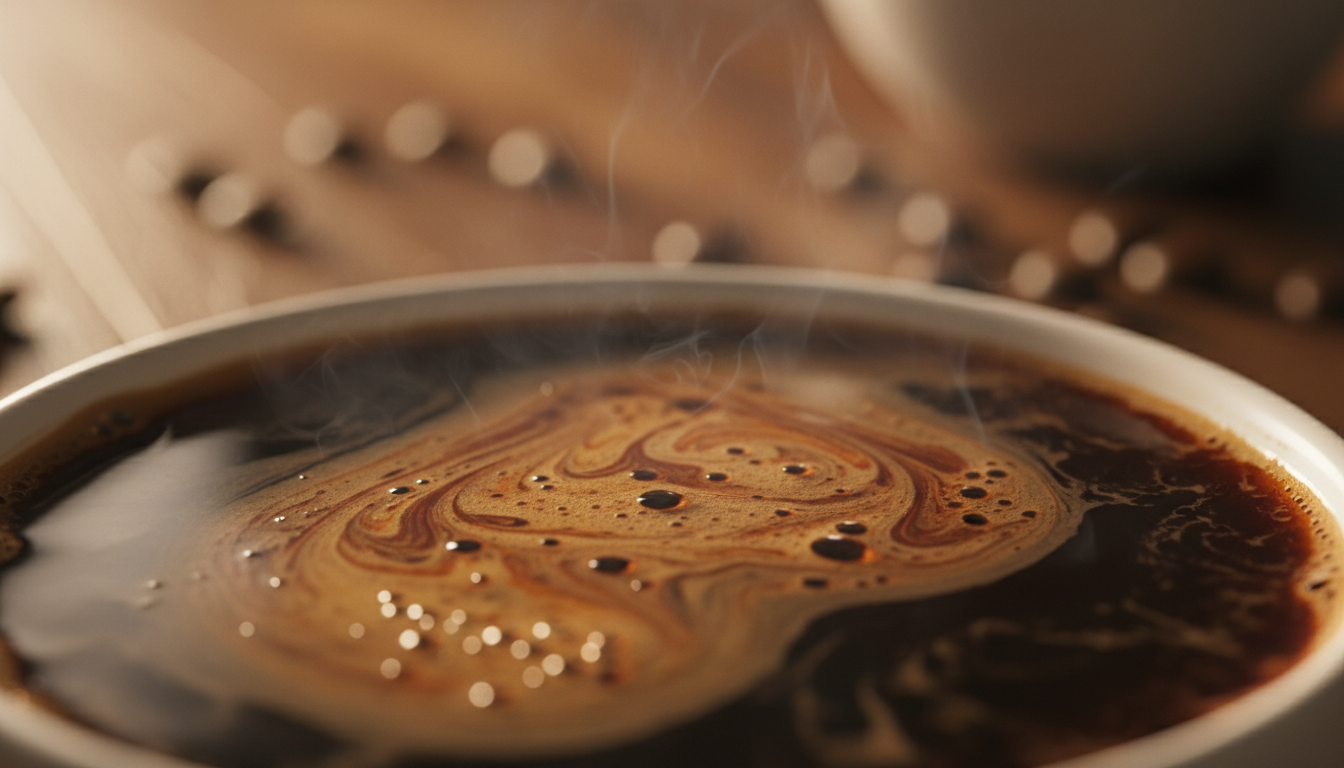
Coffee brew turbulence is the chaotic movement of water through the grounds during brewing. In plain terms, it means the liquid moves in swirls and currents that mix temperatures and concentrations. You can control some of this at home by changing pour patterns, agitation, or flow speed.
This movement matters because it helps even out extraction and can speed up the process by increasing flow velocity and local pressure. When your recipe is nearly perfect, small turbulence tweaks often deliver better results than major changes.
Important: strength (TDS) and extraction yield are different. Turbulence affects how evenly particles extract, not directly the dissolved solids in the cup. It works alongside time, temperature, grind size, and ratio, and the guide will show safe ways to increase or reduce it for pour-over and immersion methods. Espresso offers less direct control.
Key Takeaways
- Turbulence = the chaotic movement of water that evens extraction.
- Small adjustments often improve a near-perfect recipe.
- Turbulence affects extraction consistency, not TDS directly.
- Work with time, temperature, grind, and ratio—not instead of them.
- Guide covers pour-over and immersion; espresso control is limited.
What Turbulence Means in Coffee Brewing and Why It Happens
When water speeds up through a packed bed of grounds, its motion can switch from calm and layered to chaotic and mixed. That change matters because it alters how heat and solubles move through the extraction process.
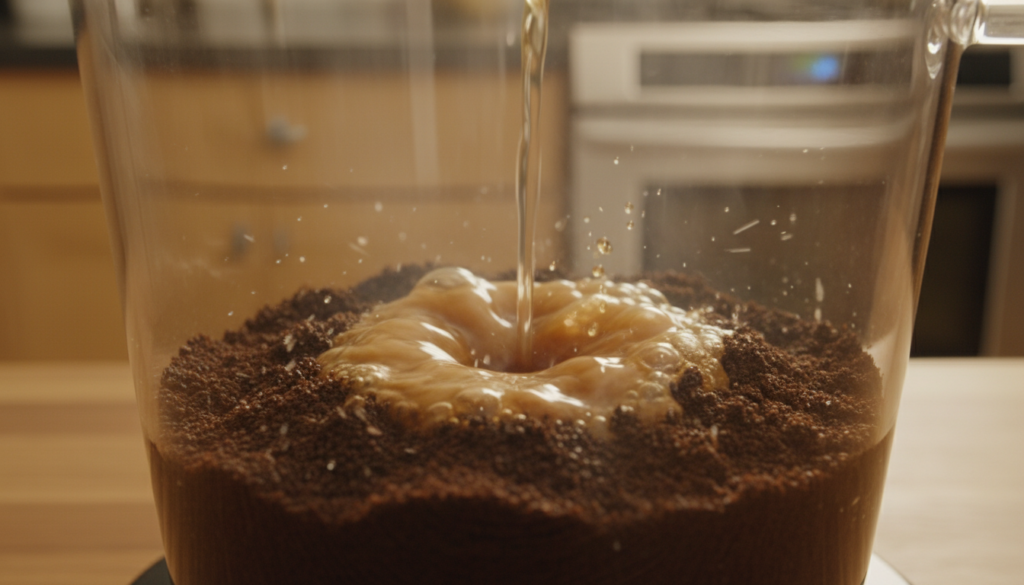
Turbulence versus laminar motion
Laminar motion is smooth and predictable. Think of dye flowing in a clear pipe in Osborne Reynolds’ classic ink-in-pipe demo.
As input velocity rises, the steady lanes break into swirls and eddies. Those eddies are the mixed motion we call turbulence.
What Would You Like to Learn Next?
Choose an option below:
How mixed motion lifts velocity and local pressure
In a porous bed made of coffee grounds, uneven channels form when water simply follows the easiest path. More mixed motion forces water into more pathways.
That raises effective speed and creates local pressure shifts. The result is fewer cool or hot spots and fewer concentrated or dilute pockets across the bed.
Why this helps even extraction
The practical payoff is clear: fewer dry clumps, fewer local over-extracted zones, and a more consistent cup from top to bottom.
Directed percolation is a useful metaphor: gravity pulls water down while mixing spreads temperature and concentration. Quantifying this in a kitchen is hard, so rely on repeatable actions and sensory feedback rather than instruments.
Bottom line: Controlled mixed motion can improve evenness and speed the process—until it becomes excessive and causes over-extraction.
How coffee brew turbulence Changes Your Cup
Small changes in flow and mixing shift which solubles leave the grounds, and that alters tasting notes more than perceived strength.
Strength vs. extraction: why strength barely changes but extraction shifts
Strength means concentration — the dissolved compounds per water volume. Movement alone rarely alters this number much without changing ratio or yield.
Extraction yield is how much you pull from the grounds. More mixing increases contact and pulls extra solubles, so extraction rises even if the cup’s concentration stays similar.
Flavor signals to watch for: bitterness and astringency as extraction climbs
Higher extraction brings more bitter and astringent compounds. Use these cues to tell strong from over-extracted.
If your cup coffee tastes hollow or sour, slightly more mixing can raise extraction and fill the body. If it is harsh or drying, reduce agitation to lower extraction.
| Measure | What it tracks | Sensory cues | Quick fix |
|---|---|---|---|
| Strength | Compound concentration | Perceived thin or full | Adjust ratio or water volume |
| Extraction Yield | Percent of solubles removed | Sweet → bitter/astringent | Tweak mixing or time |
| Compounds | Acids, sugars, bitters | Sour, sweet, drying | Balance time/temp/motion |
| Quality | Overall balance | Clean, layered, or muddled | Fine-tune grind/ratio before motion |
Time, Temperature, and Turbulence: Using the “Three Ts” to Control Extraction
The ‘Three Ts’—time, temperature, and motion—offer practical levers to shape flavor and balance. Use them in sequence so you know which change caused a result.
Dialing brew time by method
Target brew time windows work as a starting point: pour-over 3–4 minutes, AeroPress ~2 minutes, French press ~4 minutes, moka pot 3–4 minutes, and espresso 25–30 seconds. Adjust these based on grind and dose.
Choosing water temperature
Keep water between 88°C and 96°C. Hotter water raises extraction rate but reduces control and can push bitterness with fine grind or heavy agitation.
When to fine-tune motion vs change grind or ratio
If a cup is far off, change grind size (coarser to lower extraction, finer to raise it) or adjust brew ratio first. Use motion as a fine-tuning tool when the recipe is close to ideal.
Quick checklist: lock water temperature and brew time, then alter agitation in small steps so you can attribute flavor shifts to one variable.
Ways to Add or Reduce Turbulence During Brewing
How you move water during the pour often decides whether particles extract evenly or not.
Agitation from pouring
Pour height, speed, and number of pours change how much agitation the bed sees. Higher pours and faster flow increase agitation and push water into more channels.
Multiple pours raise mixing but can push fines toward the filter or collapse the bed walls. Keep your hand steady and change only one variable at a time.
- Use gentle concentric pour circles for repeatability.
- Increase pour height or phases in small steps to raise extraction.
- Reduce flow or combine pours to lower agitation and slow extraction.
Swirling the brewer
Swirling is a quick, controlled way to level the bed after a final pour or bloom. Effectiveness depends on brewer shape and filter rigidity.
Stirring with a tool
For immersion brews, a brief stirring early in the process is the most consistent way to agitate coffee. Stir once, gently, then let the grounds settle to avoid over-extraction.
Where you can’t directly control it
Devices like an espresso machine or a moka pot set flow and pressure internally. Adjust grind, dose, or recipe instead of trying to agitate mid-cycle.
Match agitation to the method
Use higher agitation for pour-over to limit channeling. For French press and cupping, favor lower motion to keep the cup smooth.
- If the cup is bitter, cut agitation or reduce number of pours.
- If it tastes sharp or under-extracted, add a small, repeatable stir or a firmer pour.
Conclusion
A reliable cup comes when time and temperature pair with controlled motion in small, repeatable steps. Treat agitation as a fine-tuning tool that nudges extraction and taste more than it changes perceived strength.
Lock time and temperature first. Then adjust how much mixing you apply. Keep each technique consistent: same pours, same swirl force, or same stirring pattern to protect quality from one trial to the next.
For your next run, change only one motion input slightly. Taste, note results, then decide if grind or ratio need altering. Pour-over often benefits from purposeful agitation, while immersion methods usually prefer brief, gentle motion.
In the end, the best turbulence level is the one that makes the coffee taste best for you.
FAQ
What does turbulence mean in coffee brewing and why does it happen?
How is turbulent flow different from laminar flow when water moves through the grounds?
Can turbulence change extraction speed or the cup’s strength?
What flavor signals indicate turbulence is affecting my cup?
How do time and temperature interact with turbulence to control extraction?
When should I adjust turbulence versus changing grind size or ratio?
How does pouring technique influence turbulence during pour-over methods?
When is swirling the brewer useful, and when can it be limiting?
Is stirring with a tool the best way to agitate during immersion brews?
Which methods limit direct control over turbulence?
How should I match turbulence to different brew methods?
Are there trade-offs to increasing turbulence to speed extraction?
Why Cheap Coffee Often Tastes Burnt
» Discover special tips and stories about coffee