How Coffee Altitude Shapes Acidity, Sweetness, and Body
Explore the effect of coffee altitude on flavor. Find out how different altitudes shape coffee's acidity, sweetness, and body.
This guide helps you use elevation cues on a bag to predict acidity, sweetness, and body before buying, grinding, or brewing. By the end, you will read MASL labels with confidence and make smarter choices for single-origin bags, blends, espresso, or filter brewing.
Elevation is a strong predictor because cooler temperatures and slower cherry maturation at higher sites support more sugars and organic acids. Low-elevation lots often lean toward rounder, chocolatier notes with softer acidity.
Note: altitude is a guide, not a guarantee. Processing, varietal, and roasting all shape the final cup. In this piece we use “acidity” as a positive trait — bright structure that lifts taste rather than a defect.
We preview four ranges (low, mid, high, ultra-high) and show typical directional changes: higher sites trend toward brighter acidity and clearer profiles; lower sites trend toward heavier body and chocolate or nut notes. The article then defines labels, explains chemistry, maps flavors by elevation, and gives a buying checklist plus at-home tasting and roast/grind/brew tweaks.
Key Takeaways
- Use MASL on bags to set expectations for acidity and body.
- Higher elevation usually means brighter acidity and cleaner cup notes.
- Lower elevation often brings fuller body and chocolate-like character.
- Processing and roast can override elevation effects.
- This guide focuses on practical predictions for U.S. buying scenarios.
What Coffee Altitude Means in the Real World
Seeing meters above sea level on a label helps set realistic expectations before you brew. MASL means meters above sea level and is the most common unit on specialty bags. Some producers still list feet, so check the unit when you compare numbers.
Elevation is best read as a range, not a single point. The same origin can include several elevations and microclimates that change the cup dramatically.
What Would You Like to Learn Next?
Choose an option below:
How elevation guides tasting expectations
Think of the number on a bag as a first-pass filter. Higher elevations often tilt toward brighter acidity and floral notes. Lower elevations tend to show rounder body and chocolate or nutty notes.
“Elevation narrows likely direction for acidity, sweetness, aromatics, clarity, and mouthfeel — it doesn’t promise exact tastes.”
Quick regional context
- Ethiopia: commonly 1,800–2,200 MASL
- Kenya: commonly 1,600–2,100 MASL
- Colombia: about 1,200–2,100 MASL
- Brazil: often below 1,200 MASL
Use case when buying: match the MASL line to your preferred level of brightness or body. Remember, a well-processed mid-elevation lot can beat a poorly handled high-elevation lot. Treat elevation as a helpful signal, not a final grade.
Why Altitude Changes Coffee Flavor Chemistry
When trees sit higher on a slope, cooler days and stronger sun shape how cherries mature.
Cooler temperature slows growth, extending the time cherries need to ripen. Longer development lets complex precursors form, which often yields clearer acidity rather than a sour note.
Sunlight at higher sites intensifies photosynthesis. That builds more sugars inside the cherries and increases perceived sweetness after roasting and extraction.
Lower oxygen and thinner air reduce respiration in the plant. Less respiration means sugars and organic acids stay in the bean instead of being consumed by the plant.
Roast and density effects
Slower growth produces denser beans. Higher bean density changes how heat moves in the roaster, so dense lots often need longer, gentler profiles. That makes light roasts safer and highlights fruit and floral notes.
Common grading labels
HG (High Grown) typically ~1,000–1,200m, SHB often 1,200m+, and SHG commonly ~1,350m+ in Central America. These tags hint at density and likely intensity, but processing and varietal still matter.
Note on species: arabica tends to grow at higher sites and gives brighter, more complex cups. Robusta favors lower elevations and usually brings heavier body and vegetal character, often with higher caffeine.
| Factor | Mechanism | Typical Impact |
|---|---|---|
| Temperature | Slower maturation | More organic acids; clearer acidity |
| Sunlight | Increased photosynthesis | Higher sugars; more perceived sweetness |
| Air / Oxygen | Lower respiration | Sugars and acids retained in bean |
| Pressure / Density | Denser beans form | Slower roast; suits light profiles |
Coffee Altitude Flavor by Elevation Range
Different elevation ranges commonly push beans toward distinct acidity, body, and aromatic notes. Use the MASL band on a bag as a practical map for likely profiles, then adjust for processing and roast.
Low elevations — under 1,000 MASL
Typical profile: lower acidity and heavier body. Expect chocolate, nut, and earth-adjacent notes.
These lots often suit darker roasts and espresso recipes that favor weight and sweetness over bright acidity.
Mid elevations — ~1,000–1,500 MASL
Typical profile: balanced sweetness with moderate acidity and smooth texture. This range works across many brew methods.
High elevations — ~1,500–1,800 MASL
Typical profile: brighter acidity, clearer fruit and floral notes, and a crisper finish that single-origin fans seek.
Ultra-high elevations — above 1,800 MASL
Typical profile: intense, sparkling acidity with tea-like structure and delicate florals. These coffees can command premium prices.
“Ranges guide expectations but do not guarantee exact tasting notes.”
How to use this: if a bag lists a range (for example 1,700–2,000 MASL), expect more brightness and clarity than a bag listing 900–1,200 MASL, all else equal. Processing and varietal can move a lot within or across these typical profiles.
How Altitude Shapes Acidity, Sweetness, and Body in Your Brew
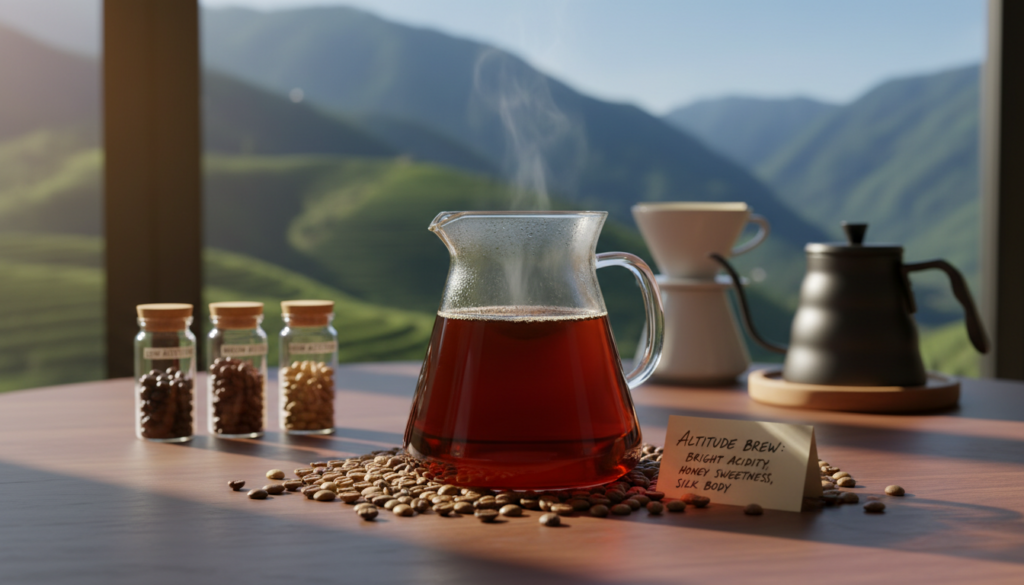
You can use the MASL on a bag to anticipate how acidity, sweetness, and body will show up when you brew. This helps you match a bag to the cup profile you prefer.
What each term means on the palate
Acidity is the bright, tactile lift you sense up front. It can feel citrusy, apple-like, or berry-driven and gives clarity to a cup.
Sweetness is the lingering perceived sugar or caramel notes. It comes from real sugars in the cherry that roast into honeyed or caramel tones.
Body describes mouthfeel — from heavy and syrupy to light and tea-like. It determines how full the brew feels on your tongue.
How these traits shift with growing level
Higher elevation slows ripening, so cherries build more sugars and retain organic acids. The result is brighter, more structured acidity and higher perceived sweetness after roast.
Lower growing zones ripen faster and often yield softer beans with muted acidity and a rounder, heavier body. Darker roast or natural processing can amplify that weight.
Practical brew examples and decisions
Using the same ratio, a 1,900 MASL washed lot will often taste crisper and more vivid than a 1,000 MASL natural lot. That difference shows how elevation and processing interact.
- Want clarity? Choose higher-level lots for brightness and cleaner finish.
- Want comfort? Pick lower-level lots for rounder body and chocolatey-sweet notes.
“These are tendencies, not rules — roast and processing can change expected outcomes.”
How to Choose Coffee Beans by Altitude, Region, and Processing
Start with the cup you want: bright citrus and floral or round, low-acid chocolatey notes. From that preference, use elevation and processing as practical filters when you shop.
Step-by-step buying checklist
- Pick taste: bright or mellow.
- Filter by elevation: 1,700+ for bright; ~1,200–1,500 for balanced; under 1,200 for low-acid body.
- Check process: washed for clarity, natural or honey for fruit and sweetness.
- Confirm origin and roast level for final fit.
Regional expectations & pairing
Regions like Ethiopia and Kenya commonly sit high and favor floral, vivid notes. Colombia highlands can be bright; Guatemala and Peru are often mid-range and balanced. Brazil and Indonesia usually list lower elevations and show heavier body.
Why higher isn’t always better
Quality depends on many factors: harvest care, clean processing, and skilled roasting. A well-made mid-elevation lot can beat a poorly handled ultra-high lot.
“Treat elevation as a learning tool—use it to build your personal preference map.”
| Goal | Elevation | Processing |
|---|---|---|
| Bright, floral | 1,700+ MASL | Washed |
| Balanced, sweet | 1,200–1,500 MASL | Honey / natural |
| Low-acid, heavy | <1,200 MASL | Natural / wet-hulled |
Simple side-by-side tasting
Buy two coffees from the same origin at different elevation bands (for example, one ~1,300 MASL and one ~1,900 MASL). Keep roast and brew recipe identical. Taste as the cup cools and note changes in acidity, sweetness, and body.
US shopper tip: when two bags list similar tasting notes, let elevation and process be the tiebreaker for expected acidity and mouthfeel.
Roast, Grind, and Brew Adjustments for Different Altitudes
Bean structure from different growing zones demands different heat, time, and grind decisions. Use these practical tweaks to get the best cup from denser, high-grown lots and softer low-grown lots.
Roasting denser vs. softer beans
Denser beans (common in higher elevations) need steady energy and patience. Give them slightly more time in the Maillard window to develop sweetness without rushing to first crack.
Use lower immediate heat and controlled ramping so bean density heats evenly. This helps avoid underdevelopment that tastes grassy or thin.
How density changes grind and extraction
Bean density affects particle breaks. Denser beans often yield a wider particle distribution at a given grinder setting. That can speed or slow extraction and change clarity.
If your cup tastes sharp or thin, try a finer grind or longer exposure (contact time). If it tastes muddy or flat, coarsen the grind or shorten contact time.
Brew method pairings and dialing tips
- High-grown beans: pour-over and light-roast espresso highlight clarity and acidity.
- Mid-range beans: AeroPress bridges clarity and body with flexible recipes.
- Low-grown beans: French press, cold brew, and milk-based espresso show body and caramel notes.
| Issue | Quick fix | Why it works |
|---|---|---|
| Sharp/thin cup | Finer grind / lower temp by 2–3°C | Increases extraction and evens solute release |
| Heavy/flat cup | Coarser grind / higher clarity method | Reduces over-extraction and improves balance |
| Uneven roast | Slower ramp / more even air flow | Helps dense beans develop without scorching |
Repeatability tip: change one variable at a time — grind, then ratio, then temperature — so you can learn how bean density affects your results.
Conclusion
Treat elevation as a directional hint that helps you pick beans that match your palate. Use MASL as a quick compass for expected acidity, sweetness, and body before you grind or brew.
Mechanism matters: higher elevation brings slower maturation, denser bean structure, and clearer acidity and sweetness in the cup. Lower elevation tends to give rounder body and chocolate or nut-forward profiles.
Keep a simple mental map when shopping: under 1,200 MASL = weight and low acid; ~1,200–1,700 MASL = balance; above 1,700 MASL = brighter, cleaner notes. Match these profiles to your preferred taste, not to a blind quality ranking.
Next step: do a side-by-side tasting with two coffee beans from the same origin at different elevations. Keep roast, grind, and ratio constant to learn the differences quickly.
Great coffee is what you enjoy most; use elevation as a guide to find consistent profiles that fit your taste.
FAQ
What does altitude mean for beans grown around the world?
Why do producers print elevation on packaging?
How does cooler temperature at higher elevations change taste chemistry?
What role does sunlight intensity play at higher elevations?
How does reduced oxygen and air pressure affect beans?
Why do denser, high-elevation beans roast differently?
What do terms like SHB and SHG mean?
How do taste profiles change across elevation ranges?
How does maturation time affect sweetness?
How does elevation influence body from cup to cup?
How should I pick beans by elevation to match my taste?
Can processing method change elevation expectations?
Are higher elevations always better?
How can I taste elevation differences at home?
How do roast, grind, and brew adjustments vary with bean density?
Which brew methods flatter different elevation ranges?
What environmental and regional factors interact with elevation?
How Long Coffee Stays Fresh After Roasting
» Discover special tips and stories about coffee