How Roast Level Changes Solubility
Understand the role of coffee roast solubility in brewing. Our how-to guide explains how roast levels affect solubility, helping you perfect your coffee.
Understanding how roast level alters solubility helps you get more consistent results at the grinder and brewer. Roasting heats green seeds to unlock aroma and flavor, and that same process changes how quickly water dissolves the compounds you want in the cup.
This guide shows why darker, more developed beans usually extract faster than lighter ones, and what to change in temperature, time, or grind size to avoid sour, thin, bitter, or ashy notes.
You’ll learn the difference between development and color, how structural changes affect extraction, and simple dialing steps for light, medium, and dark examples. No lab gear required—just practice and attention to solubility and brew variables.
Key Takeaways
- Roasting alters bean structure and chemical availability.
- Darker development often needs shorter extraction time.
- Match grind, time, and temperature to roast level for balance.
- You can improve consistency without lab tools.
- Distinguish roast color from development when dialing in.
What “solubility” means in coffee brewing
When hot water meets ground beans, some compounds dissolve and others do not. Think of the brew as a solution: the flavors and acids are the solute, and water is the solvent that carries them into the cup.
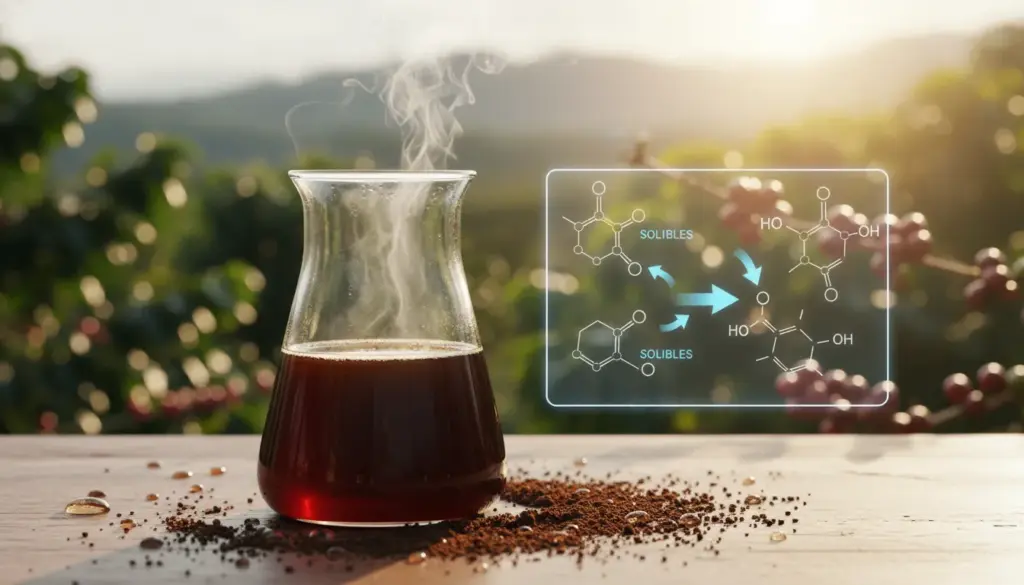
Solute + solvent: why water is the key to extraction
Water pulls out sugars, acids, caffeine, and aroma molecules. Those dissolved bits make taste, body, and finish.
Water temperature and contact time control how fast and how much of those compounds dissolve.
What Would You Like to Learn Next?
Choose an option below:
How much of a bean is actually soluble
Only about 28–32% of a green/roasted bean can dissolve in hot water. The rest — roughly 68–72% — stays as fiber, oils, and protein in the grounds.
What’s soluble vs not
Soluble: caffeine, trigonelline, chlorogenic acids and their derivatives, quinic acid, organic acids, and melanoidins.
Not soluble: most protein, cellulose, fiber, and fats. That is why no brew extracts everything, however long you steep.
Extraction yield and taste targets
| Extraction Yield | Taste | Typical Range |
|---|---|---|
| Under-extracted | Sharp, vegetal, sour, thin | <18% |
| Balanced | Sweet, integrated, rounded | 18–22% |
| Over-extracted | Dry, bitter, ashy | 22–24%+ |
Different coffees and bean density change how fast compounds dissolve. Taste, then tweak grind, time, or temperature to hit the balanced zone.
How roasting transforms coffee beans into something water can extract
Roasting turns dense green seeds into porous, fragrant beans that water can actually extract. This heat-driven transformation creates aroma, flavor, and increased solubility so brewed cups taste vibrant instead of grassy.
Roasting’s job: building aroma, flavor, and higher solubility
The main goal of the heat process is to make tasty, extractable material. A good roast produces volatile molecules and frees sugars and acids that dissolve during brewing.
Drying (yellowing) and early moisture
Drying removes initial moisture and sets the pace to first crack. Beans with higher moisture take longer and need careful control from the roaster.
Maillard reaction and volatile formation
Maillard browning makes many of the ~1,000 aroma compounds we associate with brewed cups. This stage shapes the smell and body.
Cracks and structural breakdown
First crack opens structure and boosts porosity, so grind and brew let water reach soluble parts faster. Second crack deepens breakdown and speeds extraction but risks smoky or ashy notes.
Carbonization: too far
When beans go past useful development they carbonize. That removes nuance and often adds harsh carbon flavors.
| Stage | Key change | Effect on extraction |
|---|---|---|
| Drying/Yellowing | Moisture loss | Sets pace to first crack |
| Maillard | Volatile formation | Adds aroma, increases soluble mass |
| First crack | Structural opening | Faster water access |
| Second crack | Deeper breakdown | Quicker extraction, higher risk of ashy notes |
| Carbonization | Full breakdown | Lost nuance, harsh flavors |
Overall, the further the beans progress, the more readily water finds soluble material. Adjust grind and time to match those extraction rates.
Coffee roast solubility across light, medium, and dark roast levels
Roast depth shapes how readily a brewed cup pulls flavor from grounds. That happens because heat changes bean structure and the chemical forms that water can dissolve.
Why underdeveloped light batches are harder to extract
Light, underdeveloped beans often keep denser cell walls and fewer free sugars. Water finds fewer easily dissolvable targets, so extraction is slower and yields can stay low.
Why well-developed light-to-medium is often most soluble
When development reaches the sweet spot, walls open and sugars form without burning off. That increases accessible mass and can raise the extraction rate without adding harsh notes.
The dark-roast tradeoff
Very dark processing can speed brewing but at a cost. Intense heat removes some soluble mass, leaving more bitter, carbon-like compounds and less nuanced sweetness.
Roast color, Agtron scores, and flavor shifts
Agtron gives a repeatable way to compare color across roasters. Use scores to align expectations instead of marketing names.
| Agtron Range | Common Name | Expected Flavor |
|---|---|---|
| 80–70 | Light | Citrus acids, bright |
| 70–50 | Medium | Nuts, chocolate, balanced |
| 50–40 | Medium-dark | Less acid, more body |
| 40–30 | Dark to very dark | Bitter, carbon notes |
Practical note: Expect acids → sweets/body → bitters → carbon as color deepens. Adjust grind, time, and temperature as the extraction rate shifts so that strength and quality stay balanced.
How to adjust grind size, water temperature, and time by roast level
A simple framework of grind, temperature, and time gives home brewers control over extraction rate and cup clarity.
Dialing contact time
Darker batches usually need less contact time. Shorten total time if the cup tastes bitter or ashy. For lighter batches, add time to pull more sugars and structure.
Grind size and particle consistency
Finer grind increases surface area so water reaches soluble material faster.
Keep particles uniform. Uneven grind creates mixed extraction: some bits over-extract while others stay sour or thin.
Water temperature and brew method
Use hotter water to help light beans extract sweetness. Use slightly cooler water with dark beans to slow aggressive compounds.
Immersion methods change effective contact time compared with percolation. Choose the method that lets you control time reliably at home.
Dose and taste troubleshooting
If the cup is bitter or dry, try lowering dose or shortening time. If it tastes sour or thin, go finer, increase time, or raise temperature.
Practical rule: treat roast level as a guide to set starting grind size, water temperature, and time, then adjust by taste and measured extraction.
Conclusion
, Solubility is the bridge between how a bean is developed by roasters and what the solvent pulls into your cup.
In practice, lighter or underdeveloped beans typically need more help: finer grind, higher temperature, or longer contact to reach balance. Well-developed light-to-medium beans often give the fastest path to sweetness and stable extraction. Very dark beans extract quickly but can go ashy if pushed.
Use a repeatable dialing method: change one variable at a time (grind, then time, then temperature) and taste for under- versus over-extraction. Blending coffees behaves like a weighted average; roasters still must rely on tasting, not just numbers.
Match roast level to settings, keep water consistent, and aim for quality over maximum yield to reach a good coffee cup every time.
FAQ
How does roast level change solubility in the cup?
What does “solubility” mean in brewing terms?
Why is water the key solvent for extraction?
How much of a roasted bean is actually soluble in hot water?
What compounds are soluble versus insoluble after roasting?
What extraction yield and taste targets should I aim for?
How does roasting make beans more extractable?
Why is the drying or yellowing phase important during roasting?
What role does the Maillard reaction play in cup solubles?
What happens during first and second crack that affects extraction?
How does carbonization change the solubility profile?
Why might underdeveloped light beans be less soluble?
How can well-developed light-to-medium beans be highly soluble?
Why can very dark roasting reduce soluble mass?
How do roast color measurements like Agtron relate to solubility?
How do flavors shift across levels from acids to bitters?
How should I change contact time for darker beans?
What grind adjustments help match surface area to roast level?
How should water temperature change by roast level?
When should I reduce dose or strength to avoid bitter, ashy cups?
How do I read sour, thin, bitter, or dry results to troubleshoot?
Cold Brew with Single Origin Beans: Bright vs Chocolatey Results by Region
» Discover special tips and stories about coffee