Coffee Extraction Yield Explained Without the Math
Understand coffee extraction yield and improve your brewing technique with our comprehensive guide. Get expert tips for a perfect cup.
This short guide gives a plain-English view of what extraction and yield mean for your morning cup. You will learn to separate strength from dissolved solids and to fix taste problems at home without doing calculations.
Key terms are defined up front: strength (how the cup tastes), TDS (total dissolved solids), extraction (what leaves the grounds), and yield (the fraction that ends up in the brew). These terms often get mixed up in casual talk about taste.
The promise: a simple model you can use to troubleshoot drip machines, pour-over setups, French press, or AeroPress at home. There is no single perfect number — roast, grind evenness, and personal taste all matter.
Read on to understand TDS and dissolved solids first, then how to judge extraction and uniformity, and finally a no-math dialing routine for real home brews.
Key Takeaways
- Learn basic terms so taste and strength are easier to talk about.
- Use a plain model to improve flavor, not chase numbers.
- Adjust grind and water to fix uneven or weak cups.
- Methods like drip, pour-over, press, and AeroPress share the same way of thinking.
- No single yield fits every roast or preference; aim for evenness and taste.
What coffee extraction yield means in plain English
Let’s make this simple: extraction yield is the portion of the grounds that actually dissolved into the liquid you drink. It is about how much of the coffee grounds left the puck and became part of the cup, not how dark the drink looks.
Extraction yield as “how much of the grounds ended up in your cup”
“Ended up in your cup” means dissolved material, not sediment or bits. This dissolved fraction affects clarity, balance, and the way flavors show up when you sip.
What Would You Like to Learn Next?
Choose an option below:
Why this is different from how strong the brew tastes
Strength describes concentration in the water. For example, the same dose with less water will taste stronger but may have the same extraction. You can dilute a strong cup and still detect whether the grounds were under- or over-extracted.
| Term | What it measures | Why it matters |
|---|---|---|
| Extraction yield | Fraction of grounds dissolved | Drives balance, bitterness, hollowness |
| Strength | Concentration in the brew | Affects perceived intensity and mouthfeel |
| Visible solids | Undissolved particles | Impacts clarity and texture |
Practical goal: diagnose taste first, then change grind, time, or water to move extraction rather than only making a stronger drink.
Total dissolved solids (TDS): the strength number behind brewed coffee
Total dissolved solids measure how much of the grounds actually dissolved into the water. This is the portion that becomes part of the drinkable solution, not the particles left in the filter.
What dissolved solids and TDS mean
Dissolved solids are the soluble compounds — acids, sugars, oils, and other molecules — that make flavor and body. TDS reports that mix as a percent: the concentration of dissolved material in the beverage.
Typical ranges and what they tell you
Filter brewed coffee commonly lands around ~1.3–1.45% TDS, often discussed broadly as ~1–2%. Espresso typically sits much higher, about 7–12% TDS.
| Brew type | Typical TDS (%) | What it indicates |
|---|---|---|
| Filter / drip | 1.3–1.45 | Normal strength for a balanced cup |
| Filter (broad) | 1–2 | Common conversation range for brew strength |
| Espresso | 7–12 | High concentration, thicker mouthfeel |
Limits of the number
TDS only shows concentration. A higher percent does not mean a better tasting drink. Overly high TDS can feel heavy, but bitterness often comes from what compounds were pulled, not just how concentrated the cup is.
Practical tip: use TDS as a quick sanity check for brew strength, then adjust grind, time, or method to change balance.
Coffee extraction yield: the flavor lever that changes balance, not just strength
Extraction yield is best read as a control that changes which compounds lead the cup. Small shifts move acids, sugars, and bitter notes into different roles without only changing strength.
Typical practical range for brewed coffee sits near ~18–22% (some sources cite ~19–23%). Treat this as a reference, not a rule. Different roasts and personal taste push the ideal point up or down.
Why the range matters
Some soluble compounds come out early; others take more time. So more extraction changes balance predictably: sweetness and bright acids appear first, while heavier bitter compounds arrive later.
Physical limits and palate effects
Only about ~30% of roasted bean mass is water-soluble, so yield cannot increase forever. Low yield often tastes thin or one-note. Higher yield can add body but also harshness when slow-extracting compounds dominate.
| Range | Likely result | When to aim |
|---|---|---|
| ~18% | Brighter, lighter | Light roast or accentuating acidity |
| ~20–22% | Balanced, fuller | Most filter brews |
| >22% | Heavier, risk of bitterness | When roast and evenness allow |
Practical note: the right point depends on roast level, grind evenness, and how you like the cup. Use small adjustments in grind or water to move the balance, not just to chase higher strength.
How extraction yield connects to taste (without oversimplifying)
Taste shifts as more or less of the soluble material moves from the grounds into the cup. Think of this as a sliding scale: small moves change balance more than you might expect. Use tasting, not math, to guide adjustments.
“More extracted” vs “less extracted” and why there’s no single perfect number
It helps to say more extracted or less extracted instead of strict labels. The best point depends on roast, bean quality, and how evenly the grind pulls.
Different roasts and evenness shift the sweet spot. A lighter roast may need more access to show sweetness. A darker roast can taste bitter sooner at the same pull.
What often shows up at low vs high extraction in the cup
Low extraction often reads as thin, lacking round sweetness, or simple in flavor even if the brew is strong.
High extraction tends to bring forward bitterness and astringency as slower compounds enter the cup.
Why you can’t taste extraction in isolation
Strength and concentration (tds) change how flavors feel. The same extraction percent can seem different if the cup is more or less concentrated.
Practical way: decide the flavor you want, then tweak grind, time, and ratio to move extraction in the direction that reaches it.
| Signal | Likely cause | What to change |
|---|---|---|
| Thin, one-note | Low extraction or uneven access | Finer grind, longer time, improve saturation |
| Balanced, sweet | Moderate extraction and even bed | Keep recipe, small tweaks to time |
| Bitter, astringent | High extraction or over-agitated dark roast | Coarser grind, shorter time, gentler agitation |
Uniform extraction: why the same average yield can taste totally different
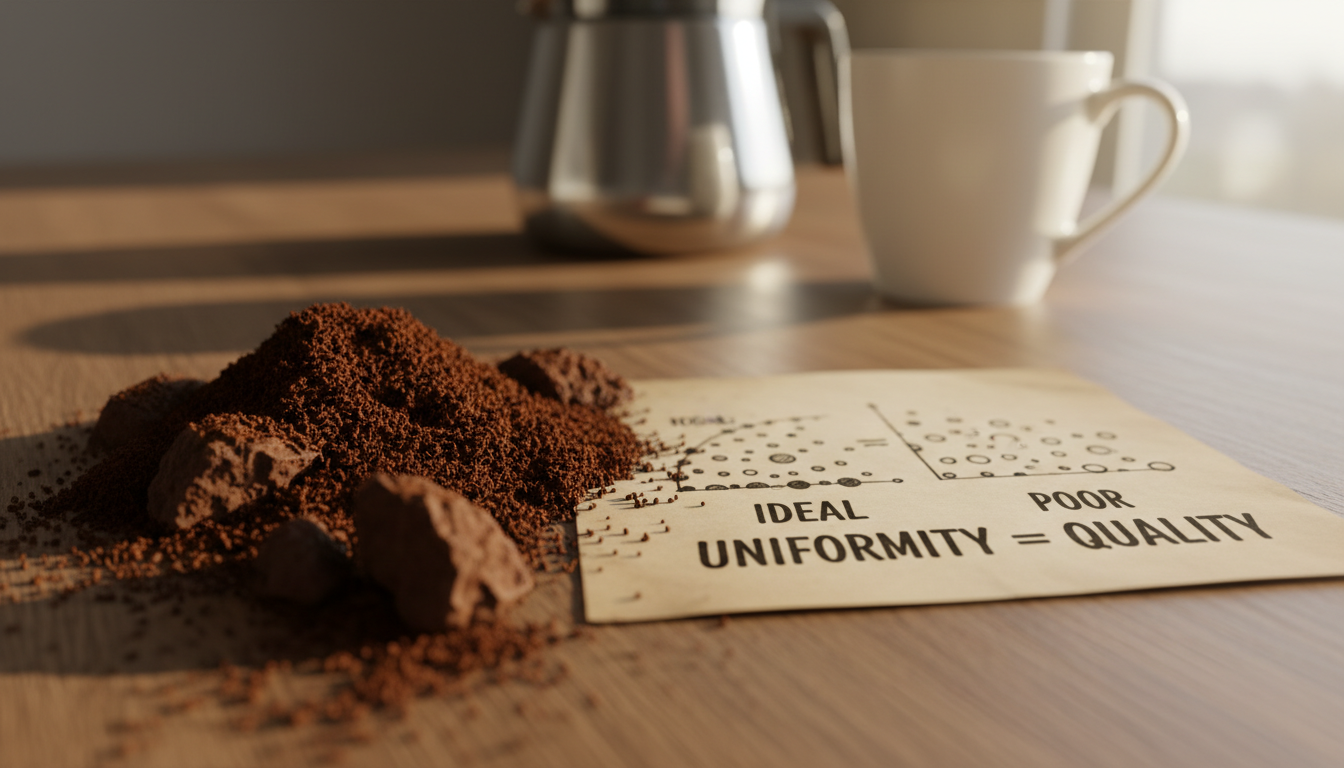
A single average number can hide a lot of turbulence inside the brew bed. An identical percent for the whole batch does not mean every particle behaved the same way.
Average versus the spread across the bed
Average extraction yield is a simple summary number. It can mask a wide distribution of how much each grain dissolved.
Some coffee grounds may be underdone while others are overdone. The final cup becomes a mix of those pieces.
How unevenness tastes and what causes it
Sensory result: you can get bright or sour notes sitting next to sharp bitterness. That makes the cup feel confused, not balanced.
- Channeling in pour‑over
- Clumps in immersion brews
- Inconsistent grind or wide particle size
- Poor saturation or dry pockets
Practical way forward: improve uniformity—finer, more even grind, better wetting, and steady water contact—to make the flavor coherent even if the average number stays similar.
| Signal | Likely cause | Easy fix |
|---|---|---|
| Sour + bitter together | Wide extraction distribution | Even grind, better saturation |
| Thin, inconsistent cup | Dry pockets or clumps | Stir early, break clumps, adjust pour |
| Heavy bitterness | Overserved fines or over‑extracted spots | Coarser grind, gentler agitation |
The two extraction processes you’re actually dealing with
Two basic processes explain why your drip brewer and espresso machine behave so differently.
Diffusion is the dominant process in most filter brew methods. Water moves into the porous structure of a ground particle, dissolves soluble material, and then moves back out. This makes the process depend strongly on contact time and access to internal pores.
How erosion changes things with very fine grinds
Erosion happens when cells are broken and soluble material washes out quickly. At very fine grind size—think espresso or Turkish—surface exposure and broken cell fragments let material leave fast.
Real detail: a typical cell is ~20 microns across. That helps explain why erosion concentrates at surfaces and in fines. The same recipe tweak behaves differently if diffusion or erosion dominates.
| Process | Dominant in | Key driver |
|---|---|---|
| Diffusion | Filter / pour‑over / drip | Contact time, pore access |
| Erosion | Espresso / Turkish | Surface area, broken cells |
| Practical tip | Adjust grind or time | Know which process dominates |
Grind size, surface area, and particle size distribution (PSD) explained
Smaller pieces speed transfer not by magic but by offering far more available surface for the same dose.
The term grind size describes how coarse or fine your ground coffee is. A population of fine particles has a much larger total surface area than the same mass in big chunks. That larger surface lets water contact more material and pull soluble compounds faster.
What PSD means and why it matters
Particle size distribution (PSD) is the mix of boulders and fines every grinder makes. Two grinders set the same can still taste different because one may produce more fines while the other leaves large cores.
Fines (often time can push a cup from bright to bitter.
Coarser particles can hide soluble material inside their cores. If water only reaches outer layers, some solids stay trapped and the effective extraction drops.
| Issue | Cause | Fix |
|---|---|---|
| Clogging / slow drawdown | Too many fines | Adjust grind or shake bed |
| Wasted material | Large boulders | Slightly finer grind or longer contact |
| Uneven cup | Wide PSD | Use a narrower setting for cleaner results |
Practical note: aiming for a narrower PSD gives a more uniform cup and saves you extra barista hustle—a straightforward way to better results.
What actually moves extraction yield up or down when you brew
Small changes in time, grind, and water produce the biggest shifts in how your cup tastes.
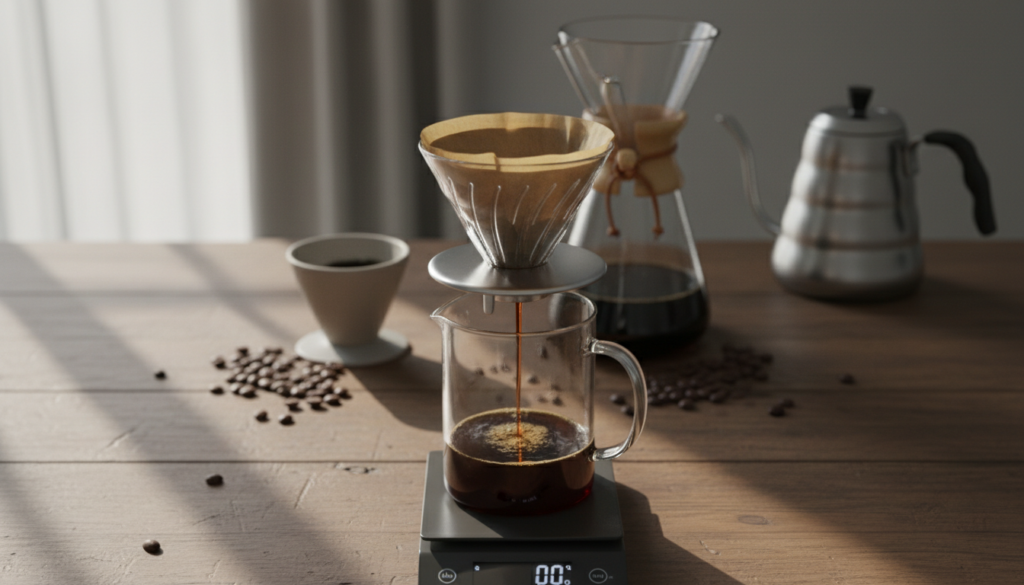
Time matters. In immersion brews, contact time is how long grounds sit in water. In pour‑over, drawdown time is the total flow period.
More time usually increases extraction, but past a point it brings bitter and astringent notes. Stop and taste before adding more minutes.
Grind, dose, and ratio made practical
Grind size controls speed and access. Go finer to increase extraction and slow flow; go coarser to reduce extraction and speed flow.
Coffee dose raises brew strength as you add more grounds. A higher dose can also leave less water per gram, which may lower how much each gram extracts.
Amount of water (brew ratio) is often 1:15–1:18 for U.S. home black brews. Wider ratios (up to 1:25) make lighter cups; tighter ratios make stronger cups.
Water access and finishing rules
Saturation is the easy fix for uneven cups. Bloom, even pouring, and brief stirring remove dry pockets and channeling.
Decision rule: change one variable at a time, keep notes, and taste to decide if you need more extraction, less extraction, or simply less strength via dilution.
| Variable | Effect on extraction | Quick tweak |
|---|---|---|
| Time | Longer = more extraction until bitterness | Shorten or lengthen by 10–30 seconds |
| Grind size | Finer = higher extraction; coarser = lower | Adjust one notch and retest |
| Coffee dose / amount water | Changes strength; alters how water interacts per gram | Use 1:15–1:18 baseline, then tweak |
| Saturation | Improves uniform extraction | Bloom, pour evenly, stir if needed |
Method matters: immersion vs percolation and what “yield” means in each
Different methods change how water meets grounds, and that alters what actually ends up in your cup.
Why immersion can pull differently than pour-over, even at similar strength
In immersion styles like French press or an AeroPress steep-and-press, grounds sit in a mixed slurry. The liquid is uniform, so dissolved material blends into the final liquid.
Percolation methods such as pour-over or drip send fresh water across the bed. That continuous flow can carry some compounds away faster and leave others behind.
What “effective extraction yield” means from the cup view
Effective extraction yield focuses on dissolved solids that actually reach the served liquid. It ignores what remains trapped in the wet grounds or in interstitial water.
This cup-focused way makes comparisons fairer. Two brews with the same strength can taste different because one method delivers a different mix of solubles to the mug.
A simple, non-mathy view of the equation idea
Think of yield as tied to two things: how concentrated the dissolved solids are and how much liquid you collect versus the dose you used.
Retained water in the grounds holds both liquid and dissolved material. That reduces the fraction that ends up in the cup and can change perceived efficiency and flavor.
| Method | How water moves | Mixing | Effect on cup |
|---|---|---|---|
| Immersion | Static contact, full mixing | High | Uniform profile, fuller body |
| Percolation | Flow through bed, fresh water | Low | Layered extraction, possible channeling |
| Practical tip | Keep dose & ratio same | Compare by taste | Adjust grind or time to match balance |
How to compare at home
Keep weight and ratio identical. Brew once by immersion and once by pour-over. Taste side by side to learn how the method alone shifts balance.
Simple rule: if the immersion cup feels fuller but muddled, make the grind slightly coarser. If the pour-over tastes thin, make the grind a touch finer or slow the flow.
Do you need a refractometer to improve your brewing process?
A refractometer gives a quick, objective check of how concentrated your cup is. It shows the amount of dissolved solids in the liquid, not whether the drink tastes balanced.
What a refractometer does (and what it can’t do)
In practical terms, a refractometer estimates tds by measuring how light bends through the solution. That reading approximates total dissolved solids and reports strength as a percent.
Limit: tds confirms concentration but cannot judge sweetness, acidity, or overall balance. Use the number as a clue, not a verdict on taste.
Digital vs handheld: practical accuracy expectations for home brewers
Handheld units often read %Brix and need a conversion. A common rule is %TDS ≈ %Brix × 0.85, but resolution can be coarse for fine tuning.
Digital coffee refractometers cost more, but many read to ~0.01% and give repeatable coffee tds useful for tight adjustments.
A simple, repeatable workflow for taking and comparing TDS readings
Follow the same steps each time so readings compare fairly.
- Hot-filter a small sample to stop further dissolution.
- Cool fully before measuring to avoid evaporation error.
- Make sure the prism is clean and the sample is well mixed.
- Record brew weight, recipe, and reading for later comparison.
| Step | Why | Quick tip |
|---|---|---|
| Sample hot & filter | Stops further change in tds | Use a syringe + cotton plug to avoid loss |
| Cool fully | Prevents evaporation and false high readings | Cover the sample while cooling |
| Measure consistently | Reduces variability between tests | Same device, same handling each time |
Use readings responsibly: treat the refractometer as a tool to separate “too strong” from “not extracted enough,” then adjust grind, water, or time and confirm by taste. This is a practical way to improve your brewing process without relying only on the equation or intuition.
Dialing in a better cup: a no-math troubleshooting routine
Start troubleshooting from the cup in your hand, not the grinder dial. Taste first. Decide if the problem is simple strength or an imbalance in how the flavors were pulled.
Separate “too strong” from “too bitter” by controlled dilution
Take a measured sip, then add a little hot water (10–20% of the cup) and taste again. If bitterness softens and notes open, the issue is mostly concentration.
If the cup tastes thin or sour: increase extraction
Try one change at a time: go slightly finer on grind size, add 10–30 seconds of brew time, or improve saturation by stirring early. Check coffee dose and water amount for consistency.
If the cup tastes harsh, bitter, or astringent: reduce over‑pull
Make the grind a touch coarser, shorten contact time, or ease up on agitation. Lower slurry temperature or reduce fines if clogging is present.
How to log recipes so you can repeat good brews
Record coffee dose, amount of water, total time, grinder setting, and a one-line taste note. Change only one variable per brew so you can link cause and effect.
Tip: use drills from Barista Hustle to practice pouring and saturation — small technique gains beat complex equation work for daily improvement.
Conclusion
Here’s a quick roadmap to turn small adjustments into consistently better cups. ,
Core model: tds or total dissolved solids shows strength, while extraction measures how much came from the grounds. Together they shape taste in your cup.
There is no single perfect number. Ranges help, but preference, evenness, and equipment set the true balance. Remember the practical levers: grind size and surface area, contact time, and making sure water wets the whole bed.
Methods differ: immersion vs percolation pull differently, and espresso relies more on erosion. Frameworks like Scott Rao’s diffusion/erosion split are tools, not rules.
Next step: pick one method, change only one variable, log results, and taste. A refractometer can confirm big errors, but good tasting and steady notes will guide most everyday improvements.
FAQ
What does "extraction yield" mean in plain English?
How is that different from how strong the drink tastes?
What are "dissolved solids" and what does TDS measure?
What are typical TDS ranges for filter and espresso?
Can TDS tell me if a cup is high quality?
What extraction range is typical for brewed coffee and why does it matter?
Why can higher or lower extraction taste less balanced?
What does "more extracted" vs "less extracted" mean for flavor?
What flavors tend to appear at low vs high extraction?
How do preferences and roast level change the "optimal" extraction?
How can the same average extraction yield taste different?
What is the difference between average extraction and extraction distribution?
How does uneven extraction cause both sour and bitter notes?
What are the two main extraction processes in brewing?
Why does a finer grind extract faster in practice?
How do fines affect flow, clogging, and flavor?
Why can coarser particles leave extractable material behind?
What brewing variables most influence extraction up or down?
How does time affect extraction and when does more time backfire?
When should you go finer or coarser to shift extraction?
How does changing the dose affect strength and extraction behavior?
What brew ratios are common in the US and how do they affect outcomes?
Why does proper water contact and saturation matter?
How do immersion and percolation methods differ in what "yield" means?
What does "effective extraction yield" mean from a cup-focused view?
Do you need a refractometer to improve your brewing?
What can a refractometer do and what can’t it do?
Are handheld and digital refractometers accurate enough for home use?
What is a simple workflow for taking repeatable TDS readings?
How do I separate “too strong” from “too bitter” without math?
If the brew tastes thin or sour, what practical adjustments help?
If the cup tastes harsh, bitter, or astringent, what should I change?
What’s a simple way to log recipes so I can repeat good brews?
Coffee Packaging Explained: What the One-Way Valve Does
» Discover special tips and stories about coffee