Coffee Extraction Time Explained for Home Brewers
Learn how to optimize your coffee extraction time for a perfect cup every time. Discover the factors that affect extraction and how to adjust them.
This short guide introduces how shot time works for home espresso makers and why it matters more as a tool than as a rule.
Start with a practical benchmark: many baristas use a 25–30 second shot as a starting recipe. That gives you a repeatable way to measure a dose, yield, and grind setting on any machine.
Timing is easy to watch and simple to record. It helps spot when grind, dose, or tamp need adjustment. But taste still decides whether a pull is successful.
Remember: a pull that hits 30 seconds can still taste off if other variables are wrong. Shots do not carry memory; change one variable and you must reassess.
Key Takeaways
- Use a starting shot time as a consistent baseline, then adjust by flavor.
- Measure grams and seconds, then tweak grind to find balance.
- Simple tools — scale, timer, and steady puck prep — yield repeatable results.
- Learn how pre-infusion, dose, and yield affect total run behavior.
- The focus here is espresso, though the same ideas apply to other methods.
What coffee extraction time really measures in your cup
Knowing how long hot water contacts the puck lets you translate taste into an actionable adjustment. Extraction time is simply the span when water meaningfully dissolves solubles from the ground bed and carries them into the cup.
Extraction time vs brew time vs contact time
These terms often blur during an espresso pull because machines add pre-infusion and pump ramps. Brew time can mean total run length, while contact time stresses the actual wetting interval inside the puck.
What Would You Like to Learn Next?
Choose an option below:
For home brewers, pick one definition and record it consistently. That creates a repeatable checkpoint for dialing recipes.
What gets pulled into the cup and why balance shifts
Hot water extracts acids, sugars, lipids, and later bitter compounds. Faster runs favor acids and lighter flavors. Very long runs push more bitters and dry compounds into the cup.
- Early: acids and bright aromatics.
- Mid: sugars and body.
- Late: bitter and astringent solids.
Why timing matters for consistency at home
Timing gives an objective number when you change beans, grind, or dose. A fast shot can taste thin and sour; a long run can go bitter—so the recorded length guides your next adjustment.
Remember that pressure and water temperature also change what extracts. Use measured runs with sensory checks and yield data to troubleshoot, not as the sole rule.
Target time ranges for espresso shot time in seconds
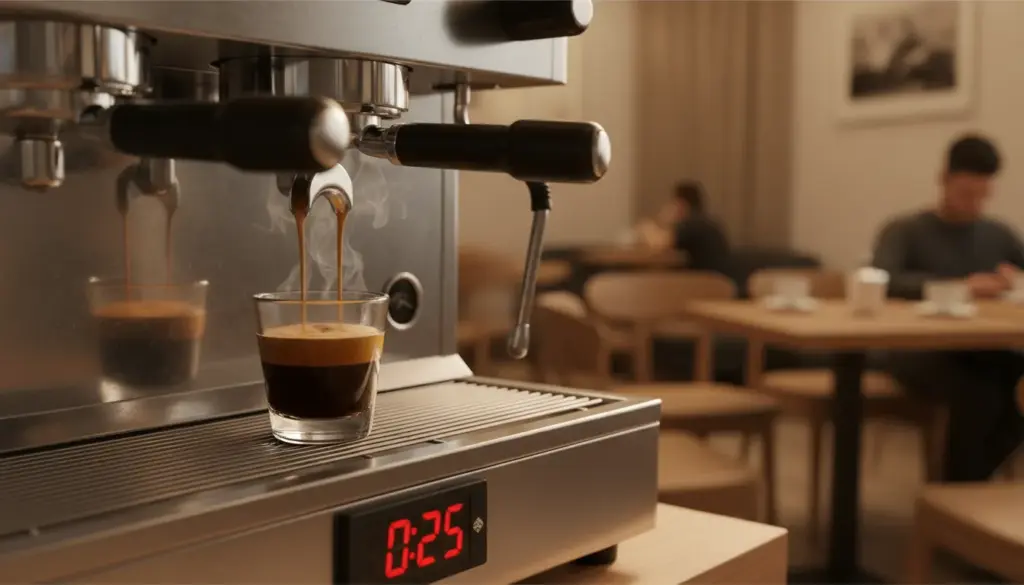
A clear seconds range speeds dialing and helps you reach a consistent cup. Use these windows as practical guides, not rigid rules.
The classic 25–30 second guideline
25–30 seconds is a solid starting point for many home setups. This window often balances flow resistance, grind, and yield to give sweetness and clarity.
A practical 25–35 second window
Move to 25–35 seconds when changing beans, roast level, grinder, or basket. The wider band accommodates real-world variation.
When 35–40 seconds can work
Longer pulls (35–40 seconds) can shine with light roasts or when using pre-infusion and flow profiling. Expect more body and developed sweetness.
- If your shot is far outside these ranges, tweak grind, dose, or puck prep.
- Basket size changes dose and yield more than it changes this benchmark.
- Always finish by tasting—use seconds to get close, then confirm by flavor.
| Range (seconds) | When to use | Typical flavor | Adjust |
|---|---|---|---|
| 25–30 | Starting recipes | Balanced sweetness & clarity | Fine-tune grind |
| 25–35 | Different beans/roasts | Broader balance | Adjust dose or basket |
| 35–40 | Light roasts / profiling | Richer body, developed sweetness | Use pre-infusion or finer grind |
When to start the timer on your espresso machine
Deciding when to start the clock affects how you record and compare recipes. Pick a single rule and use it every session. That consistency makes adjustments meaningful.
Button push: include the full process
Start at the pump or button press if you want the full picture. This method counts pump ramp, any pre-infusion, puck wetting, and the full flow into the cup.
Most pros recommend this for home use because espresso extraction begins the instant water reaches the puck. It also captures variable pump behavior and pressure buildup.
First drip: why scales sometimes begin later
Some scales auto-start at the first drip to measure net flow to the cup. That omits pre-drip seconds and can make recipes look shorter.
- To translate: subtract the pre-drip delay from button-push totals.
- Example: a 30-second button-push shot with a 10-second delay → 20 seconds on a scale that starts at first drip.
Practical advice
Different pumps and machines change the pre-drip delay. That means your number may not match someone else’s even with the same recipe.
Use the same start point, the same stop rule (often target yield), and the same tools so your dialing is repeatable.
| Start method | Includes | How to translate |
|---|---|---|
| Button push / pump start | Pump ramp, pre-infusion, puck wetting, full flow | Standard for recipes; no adjustment needed |
| First drip (scale auto-start) | Only flow into cup after first drops | Subtract pre-drip delay (example: 30s → 20s if 10s delay) |
| Recommendation | Home baristas | Start at button push; log machine-specific delays |
How pre-infusion changes total extraction time
A brief low-pressure soak before full pump pressure changes how a shot behaves and what the cup tastes like.
What pre-infusion does to the puck
Pre-infusion is the low-pressure phase that wets dry coffee grounds and lets the puck swell gently.
It reduces dry spots and helps distribution. That lowers the risk of channeling when you pair it with solid prep.
Adjusting your target when pre-infusion lasts 5–10 seconds
If your machine adds ~5 seconds of soft soak, you can usually keep a 25–30 second guide and taste for balance.
When pre-infusion is 5–10 seconds, expect total recorded runs to shift upward. Many home brewers see totals in the 35–40 second window while leaving yield unchanged.
Staying consistent when pre-infusion varies
Pick one start rule (button push is easiest) and log the full pump-on period every session. Keep dose and yield steady before changing grind.
Don’t chase numbers alone: change one variable at a time and judge flavor. If extended totals add dryness, dial finer grind or reduce pressure slightly.
| Pre-infusion (s) | Record method | Practical adjustment |
|---|---|---|
| 0–4 | Button push ≈ flow start | Use 25–30s target; adjust grind |
| 5–10 | Button push includes soak | Expect 35–40s totals; keep yield constant |
| Variable | Log machine behavior | Program or standardize start to stay repeatable |
How to dial in coffee extraction time with dose, yield, and brew ratio
Good shots come from consistent dosing, steady yield targets, and small, deliberate grind changes.
Start recipe (example): weigh 18g in and aim for ~36g out (1:2). Use a scale and stop the shot at the target yield, then taste while using a 25–30 second guideline as a reference.
Keep dose consistent when you change grind
Keep the same dose so puck depth and resistance stay stable. Changing grams alters flow and complicates what a grind change does.
Adjust yield to explore flavor
Try slightly shorter yields for brighter cups or a bit more yield for body. Do this without obsessing over the stopwatch—let the cup lead.
Single vs double basket
Basket size mainly shifts dose and yield targets. The principle stays the same: maintain ratio, log results, and prefer taste over rigid numbers.
“Extractions have no memory: change one variable at a time, measure, and taste.”
Adjust grind size to control extraction time without losing flavor
Grind size is the single most effective lever for controlling flow when dose and yield stay constant. Use the grinder first before changing dose or basket. Small, deliberate steps keep results predictable.
If your shot runs too fast
If the shot hits target yield in too few seconds, grind finer. Expect more body and sweetness as more solubles dissolve. Watch for extra bitterness if you push the grind too fine.
If your shot runs too slow
When the shot chokes or drags past the target, grind coarser. You’ll get a cleaner finish and less harshness. Go too coarse and the pull can taste sour or thin.
How roast level and bean freshness shift settings day to day
Roast and age change resistance in the puck. Darker roasts often need a coarser setting than lighter roasts. As beans degas, you may need to adjust grind slightly each week.
“Use one change at a time: tweak one notch, pull a shot, taste, and log the result.”
Example: keep 18g dose and 36g yield. Move one notch finer, pull the shot, note seconds and taste. Repeat until flavor and run match your goal.
Consistency and troubleshooting when extraction time won’t cooperate
Small changes to prep or hardware can make shot length swing from steady to wild overnight.
Channeling and puck prep
Fast paths form when distribution or tamping is uneven. Clumps or a tilted tamp let water carve channels and cut seconds from a pull.
Check distribution, use a WDT if needed, tamp level, and confirm consistent headspace. These simple steps stop many wild swings.
Accessories that change flow
Basket choice matters: hole pattern, depth, and precision baskets shift flow for the same dose.
Puck screens and filter papers raise resistance and can smooth flow. Expect to re-dial grind when you change these parts.
Machine factors to inspect
Pump behavior, nominal pressure, and water temperature all alter shot balance. Flow or pressure profiling changes the curve and the cup.
Logging and diagnosing
Keep a log: roast, dose, yield, total seconds, grinder setting, machine temp/pressure, and tasting notes. Change one variable at a time to isolate the cause.
“Extractions have no memory: change one variable at a time, measure, and taste.”
Expect minor tweaks: humidity, bean age, or a new basket will usually need a small grind adjustment to restore repeatable shots.
Conclusion
Think of seconds as data, and your palate as the final referee for each cup. Use timing to guide adjustments, but let tasting lead the decision for any espresso recipe.
Practical ranges help: start with 25–30 seconds, widen to 25–35 for different roasts, and accept 35–40 in some cases. Log dose, yield, and the recorded run so you can repeat wins or undo mistakes.
Start the clock at pump-on/button push for consistent records; if your scale begins at first drip, note the pre-drip delay so you can translate numbers. Programmable pre-infusion often makes good pulls look longer on the display.
Pick a basket and size, keep a steady recipe, and change one variable at a time. If the cup is sweet, balanced, and pleasant, your measurements are working.
FAQ
What does extraction time really measure in your cup?
How is extraction time different from brew time or contact time?
What gets extracted during an espresso shot and why does it change flavor?
Why does timing matter for consistency when brewing at home?
Why is 25–30 seconds a common starting guideline for an espresso shot?
When should I use a broader 25–35 second range?
Can longer shots like 35–40 seconds taste good?
When should I start the timer on my espresso machine?
What about timing from the first drip — how do I translate that?
What is pre-infusion and how does it change total extraction?
How should I adjust target shot time if my machine does a 5–10 second pre-infusion?
How do I stay consistent when a machine’s pre-infusion varies?
What’s a simple start recipe using dose, yield, and ratio for home baristas?
How do I keep dose consistent while changing grind size?
How can I adjust yield to explore flavor without chasing time alone?
Does single vs double basket size change anything important?
If my shot runs too fast, should I grind finer and what will I taste?
If my shot runs too slow, should I grind coarser and what will I taste?
How do roast level and bean freshness shift my grind setting day to day?
What is channeling and how does it affect shot consistency?
How do basket choice, puck screens, or filter papers affect flow?
What machine factors should I check if timing won’t cooperate?
How should I log results so my “dialed in” shots are repeatable?
What does it mean that extractions have no memory when changing variables?
Washed Ethiopia vs Natural Ethiopia: Which Tasting Notes to Expect Before You Buy
» Discover special tips and stories about coffee